The Soup Atlas
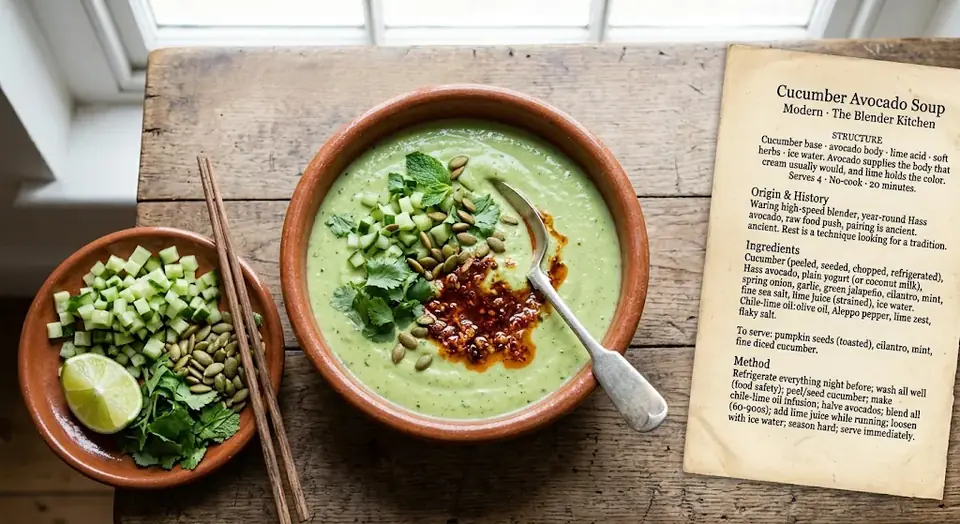
Cucumber Avocado Soup
Avocado supplies the body that cream usually would, and lime holds the color.
At a glance.
Cucumber Avocado Soup is a recipe from The Soup Atlas, in the chapter Chilled & Light Soups. It serves 4, takes about 20 minutes, and uses 18 ingredients and 10 steps.
- Yield
- Serves 4
- Method
- No-cook
- Time
- 20 minutes
Ingredients
Tap an ingredient to tick it off.
- For the base
- For the acid and adjustment
- For the chile-lime oil
- To serve
Method
-
Refrigerate everything the night before — cucumbers, yogurt, herbs, even the blender jug if it fits. There is no cooking here, and therefore no cooling stage either, so the only route to a genuinely cold soup is cold ingredients going in.
-
Wash the cucumbers and herbs thoroughly under running water before you start. Nothing in this bowl is ever heated, so nothing that arrives on the produce is ever killed; with a no-cook soup, cleanliness at the board is the whole of your food safety.
-
Peel the cucumbers, halve them and scrape out the seed channels with a teaspoon. The seeds hold the most water and the least flavor, and leaving them in produces a soup that looks right at the blender and turns thin an hour later.
-
Warm the oil for the chile-lime finish for 30 seconds in a small pan — no hotter than you can hold a finger in — then take it off the heat and stir in the chile flakes, lime zest and flaky salt. Set it aside to infuse while you work.
-
Halve the avocados, remove the stones and scoop the flesh straight into the blender. Judge them by feel at the stem end rather than by color; an under-ripe avocado gives a grassy, chalky soup, and an over-ripe one carries a bruised, faintly rancid note nothing will mask.
-
Add the cucumber, yogurt, spring onion, garlic, jalapeño, cilantro, mint and salt, and blend at high speed for 60–90 seconds, until entirely smooth and pale jade with no herb specks visible.
-
Pour in the lime juice while the machine still runs and blend for 10 seconds more. Acid goes in the moment the avocado is broken open, not at the end — it drops the pH low enough to slow the enzyme that turns cut avocado brown, and every minute of delay costs you color.
-
Loosen with ice water, 100 ml at a time, until it pours in a smooth ribbon rather than dropping in blobs. Blend briefly after each addition. Stop while it is still a shade thicker than you want; it firms up in the refrigerator within the hour.
-
Season hard and taste twice. A cold, fatty soup absorbs salt without appearing to — count on a further teaspoon — and it will usually want the juice of another half lime. Taste, wait ten seconds, and taste again before you decide it is done.
-
Serve within the hour, in bowls that have been in the freezer. Spoon over the chile-lime oil, scatter the diced cucumber, pumpkin seeds and herb leaves, and pass lime wedges. Do not leave it standing on a warm table for more than twenty minutes.
Cook’s notes
- The technique
- Avocado browns because of polyphenol oxidase, an enzyme kept apart from its substrates inside intact cells. Cut or blend the fruit and enzyme, phenolic compounds and atmospheric oxygen all meet at once, producing quinones that polymerize into brown pigment. Three things slow it: acid, since the enzyme works poorly below about pH 4; cold, which halves the reaction rate with every 10°C you drop; and excluding air, which is why cling film is pressed onto the surface. None of them stop it. Blending whips air through the whole batch, so time is against you from the first second.
- Make ahead
- Almost nothing here can be done ahead, and pretending otherwise produces a khaki soup. The chile-lime oil holds a week. The cucumber can be peeled, seeded and chilled the day before. The blending itself belongs to the last twenty minutes before serving. Refrigerated with film pressed to the surface it survives four hours, and the top centimetre can be scraped away if it dulls. It does not freeze.
- Troubleshooting
- Grey-brown within the hour — not enough lime, or it went in too late. Grassy and chalky — the avocados were under-ripe. Watery by the time it reaches the table — the cucumber seeds were left in. Bitter and metallic after a long blend — over-blended avocado; keep the machine to ninety seconds. Thin herb flecks refusing to break down — cilantro stems chopped too coarsely.
- Variations
- Coconut milk in place of yogurt makes it dairy-free and slightly sweeter, and takes chile better. A tomatillo version, blended raw with the avocado, sharpens it considerably. Blending in 150 g of cooked, chilled peas gives a firmer green and a more substantial soup. Crab or poached shrimp folded in at the table turns it into a first course.
- To serve and keep
- Serve in small, well-chilled bowls or in glasses as something to hand round, since it is rich for a large portion. Tortilla chips or thin toast go beside it, and diced cucumber or crab on top. Drink a cold, herbaceous Sauvignon Blanc or sparkling water with lime. Made in full within this recipe — Chilled Cucumber and Avocado Base, Chile-Lime Oil, Cucumber and Seed Garnish. Also listed in the Component Index at the back.
Where it comes from
This soup has no village. It is a product of two twentieth-century developments meeting: the high-speed domestic blender, which arrived with Waring in the late 1930s and became standard equipment after the war, and the year-round supermarket avocado, which followed the commercial planting of the Hass variety from Rudolph Hass's California grove — patented in 1935 — and the trade agreements that later put Michoacán fruit in northern shops in every month of the year. Cold avocado soups begin appearing in American and Australian cookbooks and restaurant menus from the 1960s onward, and the form settled during the 1990s and 2000s, when dairy-free cooking and raw food both pushed cooks toward fat that came from a fruit rather than a churn. Calling it Mexican or Californian would be flattery in both directions: what it genuinely inherits from Mexican cooking is the pairing of avocado with lime and chile, which is ancient there. The rest is a technique looking for a tradition, and it is honest to say so.
Cucumber Avocado Soup: quick answers
How long does Cucumber Avocado Soup take?
About 20 minutes.
How many does this Cucumber Avocado Soup recipe make?
This recipe serves 4.
Where does Cucumber Avocado Soup come from?
This soup has no village. It is a product of two twentieth-century developments meeting: the high-speed domestic blender, which arrived with Waring in the late 1930s and became standard equipment after the war, and the year-round supermarket avocado, which followed the commercial planting of the Hass variety from Rudolph Hass's California grove — patented in 1935 — and the trade agreements that later put Michoacán fruit in northern shops in every month of the year. Cold avocado soups begin appearing in American and Australian cookbooks and restaurant menus from the 1960s onward, and the form settled during the 1990s and 2000s, when dairy-free cooking and raw food both pushed cooks toward fat that came from a fruit rather than a churn. Calling it Mexican or Californian would be flattery in both directions: what it genuinely inherits from Mexican cooking is the pairing of avocado with lime and chile, which is ancient there. The rest is a technique looking for a tradition, and it is honest to say so.
More in Chilled & Light Soups
 GazpachoSpain · Andalusia, the Modern Bowl
 Chilled Cucumber SoupEastern Europe · Sour Cream and Dill
 VichyssoiseFrance & the United States · The Ritz-Carlton, 1917
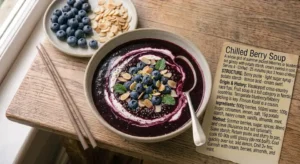 Chilled Berry SoupSweden & Finland · Blåbärssoppa
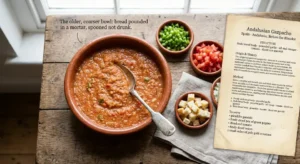 Andalusian GazpachoSpain · Andalusia, Before the Blender
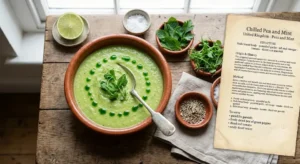 Chilled Pea and MintUnited Kingdom · Peas and Mint
https://www.atlasserie.com/recipes/soup/cucumber-avocado-soup/