The Soup Atlas
Chilled Carrot & Ginger
The roasted carrot soup at 23, rebuilt thinner, sharper and served cold.
At a glance.
Chilled Carrot & Ginger is a recipe from The Soup Atlas, in the chapter Chilled & Light Soups. It serves 4, takes about 5 hours, and uses 23 ingredients and 10 steps.
- Yield
- Serves 4
- Method
- Chilled
- Time
- 5 hours
Ingredients
Tap an ingredient to tick it off.
- For the carrot-top and ginger stock
- For the soup
- For the cold seasoning
- To finish
Method
-
Make the stock first so it has time to cool: simmer the carrot tops and peelings, onion, ginger trimmings, celery, coriander stems and peppercorns in the cold water for 30 minutes, then strain. It carries the same flavor as the soup rather than adding a competing one.
-
Heat the oven to 220°C (425°F). Toss the carrots with the oil and the teaspoon of salt, spread them in a single layer on a tray and roast for 30–35 minutes, turning once, until they are tender and browned at the tips and edges.
-
Roast them harder than you would for a hot soup. Caramelization builds flavor compounds that survive chilling, whereas the fresh, volatile aromatics that carry a hot bowl are mostly lost once the soup is cold and no longer steaming under your nose.
-
Soften the chopped onion and garlic in a pot over medium-low heat for 8 minutes, add the grated ginger, cumin and turmeric, and cook for 30 seconds more, until the spices smell toasted rather than dusty. Ground spices need fat and heat to release, and 30 seconds is the limit before they scorch.
-
Add the roasted carrots and 1 liter of the stock, bring to a simmer and cook for 15 minutes, until the carrots break apart under a spoon and the liquid has taken on their color.
-
Blend in batches no more than a third full, lid vented and covered with a folded towel, until entirely smooth. Then pass it through a fine sieve. Carrot is fibrous, and cold makes every surviving strand register on the tongue.
-
Stir in the coconut milk while the soup is still warm so it disperses evenly, then cool it fast over an iced water bath and refrigerate, uncovered until cold and covered thereafter. Chill for at least 4 hours.
-
Take it out and look at it before you taste it. It will have set noticeably thicker — starch from the carrot has retrograded and the coconut fat has firmed below about 24°C — and what poured freely from the pan now drops from the ladle in a mass.
-
Thin it with the reserved 200 ml of cold stock, or more, until it pours in a smooth ribbon. Expect to add 15 to 20 percent more liquid than a hot version of the same soup would ever take. Blend for 10 seconds to bring it back together.
-
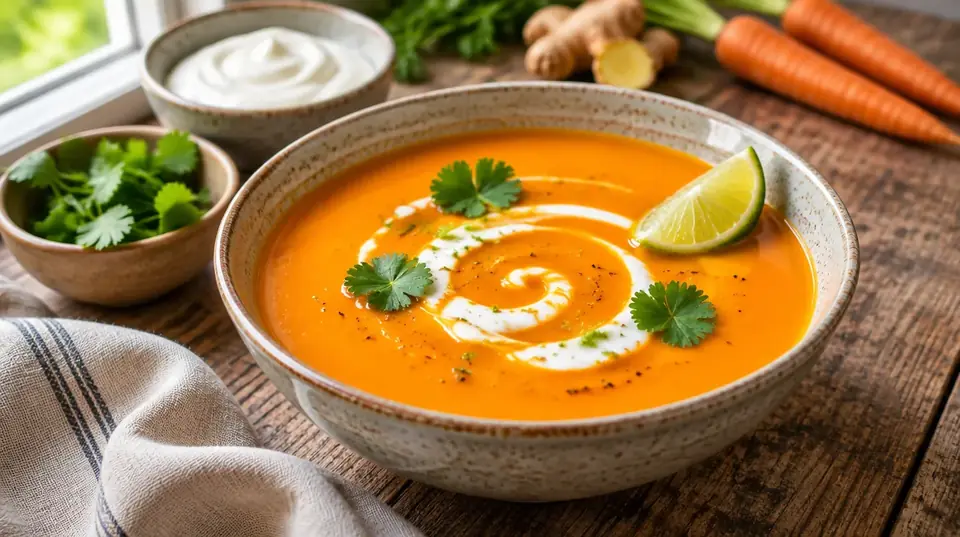
Now season it cold and season it hard: most of the salt goes in here, along with the lime juice and the squeezed ginger juice, which restores the raw heat that cooking flattened. Taste, wait, taste again. Serve in chilled bowls with swirled coconut milk, seeds, coriander and chile flakes.
Cook’s notes
- The technique
- A purée thickens as it cools, and it does so for two reasons that compound each other. Gelatinized starch molecules realign into ordered structures as the temperature falls — retrogradation — which stiffens the liquid around them, and any solid fat present, coconut fat especially, begins to crystallize below roughly 24°C. Between them, a soup that ran like cream at 70°C can hold a spoon upright at 4°C. The consequence is a rule: build a cold purée deliberately thinner than looks right, chill it fully, then adjust again with cold liquid. Judging consistency in a warm pan is guessing.
- Make ahead
- The base is better made a day ahead and holds four days refrigerated, since the ginger and cumin settle and deepen. Freeze it before the coconut milk goes in — coconut fat separates on thawing and needs hard blending to recombine. Do the final thinning, salting and liming on the day, and add the fresh ginger juice within the hour, as its heat fades.
- Troubleshooting
- Thick and pasty from the fridge — expected, and corrected with cold stock rather than water. Flat and sweet — under-salted and under-limed while cold. Fibrous on the tongue — it was blended but not sieved. Grainy with white specks — the coconut milk was added to a soup that was too hot, or it was frozen; blend it hard. Dull orange color — the carrots were not roasted long enough.
- Variations
- Serve the same base hot and it becomes the roasted carrot and ginger soup at 23, needing a third less liquid and half the salt. Yogurt in place of coconut milk gives a sharper, lighter bowl. Roasted parsnip swapped for a third of the carrot adds an earthier note. A little orange juice with the lime pushes it toward a first course rather than a light lunch.
- To serve and keep
- Serve very cold in shallow bowls or small glasses, with the coconut swirled across the surface and seeds for texture. Flatbread or a coriander-heavy salad go alongside. It suits a hot evening and a first course. Drink a dry Riesling, or sparkling water with lime and ginger. Made in full within this recipe — Carrot-Top and Ginger Stock, Roasted Carrot Base, Cold Ginger and Lime Seasoning, Toasted Seed Finish. Also listed in the Component Index at the back.
Where it comes from
Serving a hot purée cold is a restaurant convention rather than a folk tradition, and it has a traceable shape. Cold soups were a fixture of grand hotel dining from the interwar years onward, largely on the model of vichyssoise at 74, and by the 1970s the format had spread to almost any vegetable that could be blended smooth. Carrot with ginger belongs specifically to North American health-food and hotel cooking of the 1970s and 1980s, when ginger moved from a baking spice to an everyday aromatic in Western kitchens and carrots were reliably sweet year-round. Coconut milk came later, arriving with the broad popularization of Southeast Asian cooking in the 1990s. None of that gives the dish a homeland, and it would be dishonest to invent one. What it does have is a genuine technical identity, because a purée served cold is not the same recipe served at a different temperature. Its viscosity, its seasoning and its balance of acid all have to be rebuilt, and that rebuilding is what this entry is about.
Chilled Carrot & Ginger: quick answers
How long does Chilled Carrot & Ginger take?
About 5 hours.
How many does this Chilled Carrot & Ginger recipe make?
This recipe serves 4.
Where does Chilled Carrot & Ginger come from?
Serving a hot purée cold is a restaurant convention rather than a folk tradition, and it has a traceable shape. Cold soups were a fixture of grand hotel dining from the interwar years onward, largely on the model of vichyssoise at 74, and by the 1970s the format had spread to almost any vegetable that could be blended smooth. Carrot with ginger belongs specifically to North American health-food and hotel cooking of the 1970s and 1980s, when ginger moved from a baking spice to an everyday aromatic in Western kitchens and carrots were reliably sweet year-round. Coconut milk came later, arriving with the broad popularization of Southeast Asian cooking in the 1990s. None of that gives the dish a homeland, and it would be dishonest to invent one. What it does have is a genuine technical identity, because a purée served cold is not the same recipe served at a different temperature. Its viscosity, its seasoning and its balance of acid all have to be rebuilt, and that rebuilding is what this entry is about.
More in Chilled & Light Soups
https://www.atlasserie.com/recipes/soup/chilled-carrot-and-ginger/