India · The Everyday Pot · 22.82° N, 79.54° E
Dal
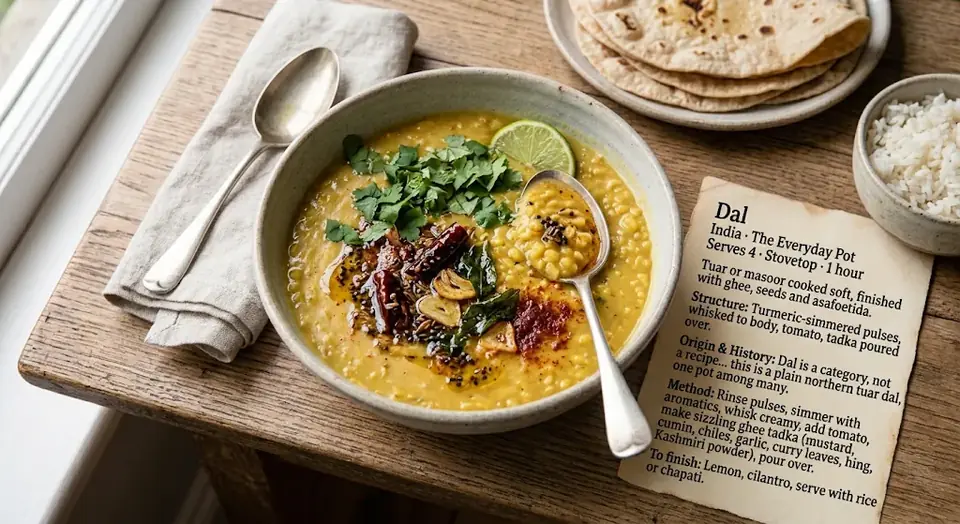
Tuar or masoor cooked soft, finished with ghee, seeds and asafoetida.
At a glance.
Dal comes from India · The Everyday Pot and appears in The Soup Atlas, in the chapter Beans, Lentils & Grains. It serves 4, takes about 1 hr, and uses 19 ingredients and 10 steps.
- Yield
- Serves 4
- Method
- Stovetop
- Time
- 1 hr
Ingredients
Tap an ingredient to tick it off.
- For the dal
- For the tadka
- To finish
Method
-
Rinse the dal in a bowl of cold water, rubbing the grains between your palms and pouring off the cloudy water, four or five times until it runs nearly clear. This removes surface starch and dust and makes the difference between a clean pot and a gluey one.
-
Put the dal in a large pot with the water, turmeric, grated ginger, split green chile and the two teaspoons of oil. Bring to a boil. The oil keeps the foam from climbing the sides, an old kitchen trick that works.
-
Skim off the thick grayish froth that gathers in the first five minutes and discard it. Then drop the heat to a steady simmer, half-cover the pot, and cook for 35–45 minutes, until the grains have swollen, split and lost all definition.
-
Every ten minutes or so, beat the dal for a few seconds with a whisk or a wooden masher. This is what turns a pot of soft pulses into an even, creamy dal; left alone, it separates into solids at the bottom and cloudy water on top.
-
Add the chopped tomato and the salt and cook for a further 8 minutes, until the tomato has collapsed and disappeared into the body of the dal. Check the consistency — it should pour from a ladle in a thick stream, and you can thin it with boiling water.
-
Now set out everything for the tadka within reach of the stove, in the order you will use it. From the first seed hitting the fat to the pan coming off the heat is about ninety seconds, and there is no time to fetch anything.
-
Heat the ghee in a small heavy pan over medium-high heat until it shimmers and a single mustard seed dropped in spins and cracks at once. Add all the mustard seeds and cover loosely with a lid or a spatter screen; they will pop hard for 20–30 seconds.
-
When the popping slows, add the cumin seeds. Give them 10 seconds — they should sizzle and darken by one shade only — then the broken dried chiles for 5 seconds, then the sliced garlic. Stir constantly until the garlic is pale gold, about 30 seconds.
-
Stand back and add the dry curry leaves. They contain water and will spit violently for a few seconds. Immediately take the pan off the heat, count to two, then stir in the asafoetida and Kashmiri chile powder, which need residual heat only. Both burn in seconds over a flame.
-
Pour the entire contents of the pan, fat and all, over the surface of the dal. It will hiss and bloom upward. Stir it through, add the lemon juice and cilantro, and serve at once with rice or hot chapati.
Cook’s notes
- The technique
- Tempering is a sequence, and the order follows how much heat each ingredient can take. Mustard seeds go first because they need genuinely hot fat to pop and release their pungency; cumin follows because it browns faster and turns bitter if it goes in alongside; dried chiles and sliced garlic come next and want only enough time to color; curry leaves are added late and crackle because of their water content. Asafoetida goes in last, off the heat, and needs no more than a couple of seconds — it is a resin dissolved by fat, and it scorches almost instantly. One honest note: most commercial hing is cut with wheat flour, so it is not reliably gluten-free.
- Make ahead
- The dal base keeps four days refrigerated and freezes for three months, thickening as it stands; loosen it with boiling water and beat it smooth again. Always temper fresh, into the reheated pot — a tadka stirred in yesterday tastes of nothing today. A pressure cooker cuts the boiling stage sharply: tuar dal needs about 8 minutes at high pressure, masoor about 5, with a natural release.
- Troubleshooting
- Watery on top with sludge beneath — it was not beaten during cooking; whisk it hard over low heat. Bitter tadka — the cumin or garlic went too dark, or the asafoetida hit a live flame; start the tempering again, it costs a few minutes. Dal still hard after an hour — old stock, or hard water; a pinch of baking soda helps but dulls the flavor. Flat — under-salted, then under-soured.
- Variations
- Masoor dal cooks in half the time and turns a soft gold. Moong dal is the lightest and is what convalescents are given. A Gujarati hand adds jaggery and kokum for a sweet-sour pot; a Bengali one tempers with panch phoron and a whole dried chile; a South Indian one leans on curry leaves, tamarind and more hing. Dal fry browns onion and tomato in the tadka pan before it goes in.
- To serve and keep
- Serve in small bowls beside rice, or poured directly over it, with chapati or paratha, a lime pickle and a spoonful of plain yogurt. A little extra ghee melting on the surface is not excess. Drink water, buttermilk or salted lassi. Made in full within this recipe — Tadka, Boiled Dal Base. Also listed in the Component Index at the back.

Where it comes from
Dal is a category rather than a recipe, and it is worth being honest about that before cooking any of it. The word covers the split pulses themselves — tuar or arhar, masoor, moong, urad, chana, kulthi and more — and also the dishes made from them, which run into the hundreds and are not variations on one another. Punjabi dal makhani simmers whole urad and kidney beans overnight with butter and cream. Bengali cholar dal cooks chana with coconut, raisins and whole garam masala. Gujarati dal is sweet, sour and thin, seasoned with jaggery and kokum. Tamil paruppu is plain and soft, eaten with ghee and rice before anything else on the plantain leaf, while sambar is a different construction entirely. Andhra pappu, Maharashtrian varan and amti, Odia dalma: each is a fixed dish with its own rules. What they share is the finish. The tempering has as many names as it has regions — tadka, chhaunk, baghar, phodni, vaghar, thalippu — and the recipe below is a plain northern tuar dal, one pot among a great many.
Dal: quick answers
How long does Dal take?
About 1 hr.
How many does this Dal recipe make?
This recipe serves 4.
Where does Dal come from?
Dal is a category rather than a recipe, and it is worth being honest about that before cooking any of it. The word covers the split pulses themselves — tuar or arhar, masoor, moong, urad, chana, kulthi and more — and also the dishes made from them, which run into the hundreds and are not variations on one another. Punjabi dal makhani simmers whole urad and kidney beans overnight with butter and cream. Bengali cholar dal cooks chana with coconut, raisins and whole garam masala. Gujarati dal is sweet, sour and thin, seasoned with jaggery and kokum. Tamil paruppu is plain and soft, eaten with ghee and rice before anything else on the plantain leaf, while sambar is a different construction entirely. Andhra pappu, Maharashtrian varan and amti, Odia dalma: each is a fixed dish with its own rules. What they share is the finish. The tempering has as many names as it has regions — tadka, chhaunk, baghar, phodni, vaghar, thalippu — and the recipe below is a plain northern tuar dal, one pot among a great many.
More from India


More in Beans, Lentils & Grains



https://www.atlasserie.com/recipes/soup/dal/