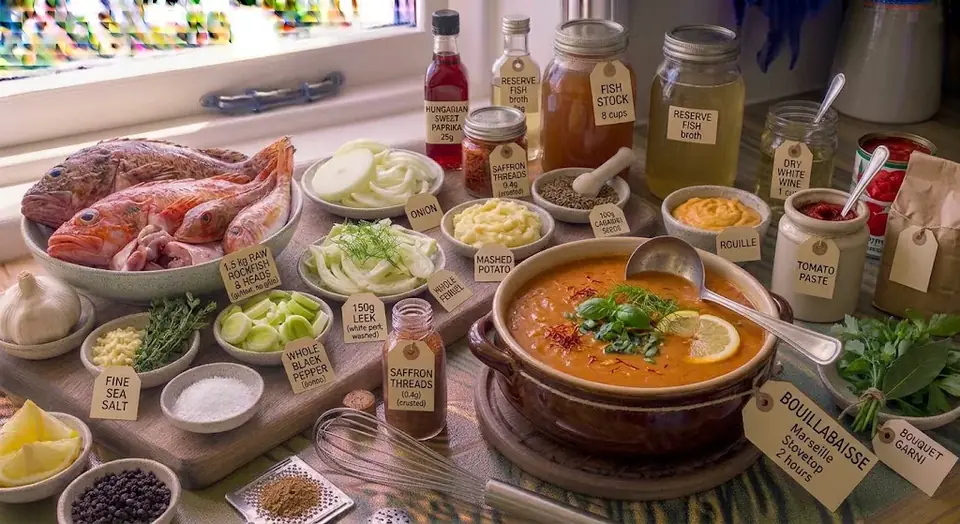
France · Marseille · 46.56° N, 2.35° E
Bouillabaisse
Rockfish broth with saffron and fennel, the fish poached and served after.
At a glance.
Bouillabaisse comes from France · Marseille and appears in The Soup Atlas, in the chapter Hearty Stews & Chowders. It serves 6, takes about 2 hours, and uses 28 ingredients and 10 steps.
- Yield
- Serves 6
- Method
- Stovetop
- Time
- 2 hours
Ingredients
Tap an ingredient to tick it off.
- For the broth
- For the saffron
- For the fish, in order of thickness
- For the rouille
- For the croutons
Method
-
Rinse the fish frames until the water runs clear and cut out every gill — gills hold blood and iodine bitterness, and they will muddy a broth you cannot then repair. Chop the small whole fish into three or four pieces each, bones and all.
-
Warm the olive oil in a large pot and cook the onion, fennel and leek over medium heat for 12 minutes until soft. Add the garlic, fennel seeds and orange peel for a minute, then the small fish and the frames, and stir over medium-high heat for 5 minutes until the flesh whitens.
-
Add the tomatoes, wine, water, bay, thyme and salt. Bring to a boil, then drop to a steady simmer and cook uncovered for 40 minutes. Break the fish up with a wooden spoon as it goes — unlike a delicate fumet, this broth wants agitation, because you are extracting everything the bones hold.
-
Pass the whole pot through a food mill fitted with its coarse plate, or push it hard through a colander and then a fine sieve, pressing with a ladle until only dry bone and skin remain. Discard the debris and return the thick, coral-colored broth to a clean pot. You should have 1.6–1.8 liters.
-
Steep the crumbled saffron in a ladle of the hot broth for 10 minutes. It draws far more color and aroma out this way than by dropping the threads into the pot, where most of what you paid for stays locked in the stigma.
-
Simmer the potato discs in the broth for 12 minutes until tender, lifting them into a warm dish as they are done. Take out one small floury potato for the rouille and mash it while it is hot.
-
Make the rouille: pound the garlic, saffron and chili to a paste with the salt, work in the mashed potato and then the egg yolk, and add the oil in a thin stream while stirring in one direction. It should stand a spoon up. Loosen with broth and sharpen with lemon.
-
Toast or fry the baguette slices until crisp all the way through, then rub each hot surface with the cut garlic. Anything softer than a biscuit will vanish into the broth within a minute.
-
Bring the broth to a boil and add the saffron infusion. Poach the fish in stages by thickness: monkfish or conger for 8 minutes, the on-the-bone fish for 5, the fillets for 3. Keep it at a light boil throughout — that is what emulsifies the oil into the broth and gives it body.
-
Lift the fish onto the warm dish with the potatoes and moisten it with a little broth. Serve the broth first in bowls, with croutons floating and rouille spread on them, then bring out the fish as the second course with the remaining rouille and croutons alongside.
Cook’s notes
- The technique
- Say the difficult thing plainly: outside the Mediterranean you cannot make bouillabaisse, only a fine fish soup in its shape. The charter is right about that. Rascasse and its neighbors live among rock and weed, they are small, bony and full of gelatin, and they carry an iodine-and-mineral flavor that no farmed fillet supplies. What is achievable anywhere is the method — many small whole fish milled bones and all, a hard emulsifying boil, orange peel, fennel and steeped saffron. Buy the ugliest, boniest fish you can find, use at least four kinds, and accept a rounder, less wild broth.
- Make ahead
- The broth is better made a day ahead and holds three days refrigerated or three months frozen; it sets to a soft jelly if you have used enough bone, which is the sign you did it right. Rouille keeps two days covered in the fridge and should be brought back to room temperature. Fish is poached to order — there is no version of this you reheat.
- Troubleshooting
- Bitter — gills or blood were left in the frames. Thin and gray — too few bones, or the broth was strained rather than milled, so the gelatin and flesh went in the bin. Rouille split — start a fresh yolk in a clean bowl and beat the broken sauce into it drop by drop. Fish falling apart on the platter — it was poached above a gentle boil, or lifted with tongs instead of a slotted spatula.
- Variations
- Bourride, the other great Provençal fish soup, drops the saffron and thickens with aïoli whisked into the hot broth off the heat. Soupe de poissons is this same milled broth served alone with rouille and no whole fish, and it is the honest choice when you cannot get good pieces. A Catalan turn adds a picada of almonds and fried bread to the broth.
- To serve and keep
- Two courses from one pot: broth first in wide bowls, croutons and rouille passed at the table, then the fish and potatoes on a platter with more broth spooned over. Grated Gruyère is traditional on the croutons in Marseille kitchens. Drink a chilled Cassis or Bandol rosé. Made in full within this recipe — Rockfish Broth, Saffron Infusion, Rouille, Garlic Croutons. Also listed in the Component Index at the back.

Where it comes from
Bouillabaisse began on the beaches of Marseille as the fishermen's own meal, boiled up from the spiny, bony rock-dwellers that no buyer wanted, and its name is generally read as an instruction: bring to the boil, then lower. Its rise from waterfront food to expensive restaurant dish happened across the twentieth century, and with the money came anxiety about authenticity. In 1980 a group of Marseille restaurateurs signed the Charte de la Bouillabaisse Marseillaise, a voluntary charter setting out what the name should mean. It requires the soup to be made from Mediterranean rockfish, names the species that may appear — rascasse, or scorpionfish, above all, with galinette, congre, saint-pierre, baudroie and vive among the permitted others — asks for a minimum of four, and specifies the service: the fish presented whole at the table, filleted in front of the guest, the broth served first with rouille and croutons. The charter has no legal force. It is a statement of what a city thinks its own dish is, which is a different and more interesting kind of authority.
Bouillabaisse: quick answers
How long does Bouillabaisse take?
About 2 hours.
How many does this Bouillabaisse recipe make?
This recipe serves 6.
Where does Bouillabaisse come from?
Bouillabaisse began on the beaches of Marseille as the fishermen's own meal, boiled up from the spiny, bony rock-dwellers that no buyer wanted, and its name is generally read as an instruction: bring to the boil, then lower. Its rise from waterfront food to expensive restaurant dish happened across the twentieth century, and with the money came anxiety about authenticity. In 1980 a group of Marseille restaurateurs signed the Charte de la Bouillabaisse Marseillaise, a voluntary charter setting out what the name should mean. It requires the soup to be made from Mediterranean rockfish, names the species that may appear — rascasse, or scorpionfish, above all, with galinette, congre, saint-pierre, baudroie and vive among the permitted others — asks for a minimum of four, and specifies the service: the fish presented whole at the table, filleted in front of the guest, the broth served first with rouille and croutons. The charter has no legal force. It is a statement of what a city thinks its own dish is, which is a different and more interesting kind of authority.
More from France




More in Hearty Stews & Chowders


https://www.atlasserie.com/recipes/soup/bouillabaisse/