Hungary · The Great Plain · 47.20° N, 19.34° E
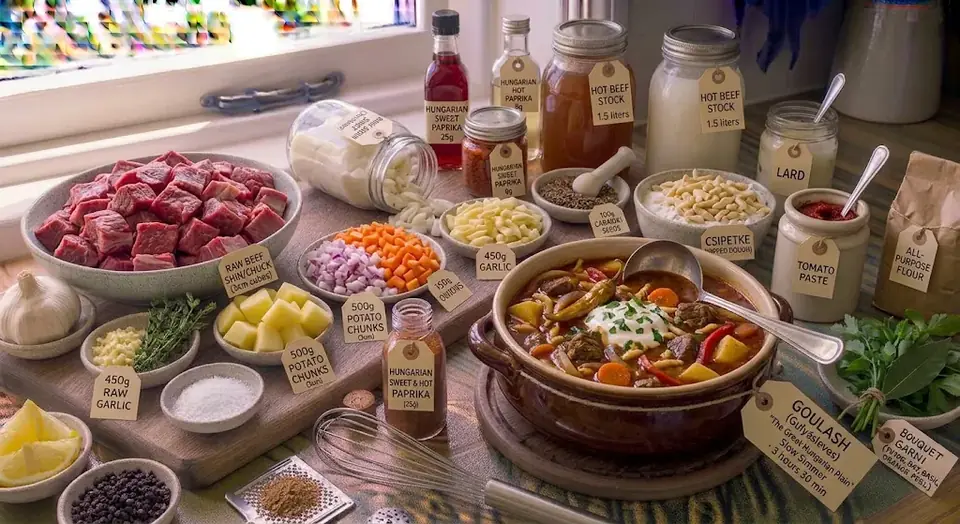
Goulash
Beef, onion and paprika in a soup deep enough to eat as a meal.
At a glance.
Goulash comes from Hungary · The Great Plain and appears in The Soup Atlas, in the chapter Hearty Stews & Chowders. It serves 6, takes about 3 hr 30 min, and uses 21 ingredients and 10 steps.
- Yield
- Serves 6
- Method
- Slow simmer
- Time
- 3 hr 30 min
Ingredients
Tap an ingredient to tick it off.
- For the pot
- For the paprika, added off the heat
- For the vegetables
- For the csipetke
- To serve
Method
-
Dry and salt the beef, then brown it in the lard in three batches over high heat, 5 minutes a batch, until each cube has a dark crust on two faces. Set the meat aside and leave the fat and the stuck residue in the pot.
-
Turn the heat down and cook the onions with a pinch of salt for 20–25 minutes. They must go past soft to a deep, collapsed gold. This is nearly the same weight of onion as meat, and as they break down they become the body of the soup. No flour appears in this recipe.
-
Stir in the garlic and crushed caraway and cook for 1 minute. Now take the pot off the stove completely and set it on a cold surface. Wait thirty seconds for the base to drop out of scorching range.
-
Add both paprikas and the tomato paste to the residual heat and stir hard for 20–30 seconds, until the fat turns brilliant red. Immediately pour in a ladleful of hot stock to arrest it. Paprika is largely sugar and pigment, and it scorches in seconds on a hot base.
-
Return the beef with its juices, add the remaining stock, and bring the pot up to the barest simmer. Cover with the lid ajar and cook for 2 hours, checking that the surface only trembles. Skim the foam early and the fat as it gathers.
-
Make the csipetke while it cooks: work the flour, egg and salt into a stiff, dry dough, knead it for 2 minutes, then rest it under a bowl for 20 minutes. Pinch off fingernail-sized pieces, flatten each between thumb and forefinger, and leave them to dry on a floured tray.
-
After 2 hours, add the peppers, tomatoes and carrots and cook for 20 minutes. Then add the potatoes and cook for a further 20–25 minutes, until they are tender and the beef pulls apart under a fork with no resistance at all.
-
Drop the csipetke into the simmering soup and cook for 5 minutes, until they float and turn from chalky to translucent at the edges. They will thicken the broth very slightly as they release starch, which is exactly what they are for.
-
Judge the consistency. Gulyásleves is a soup: the ladle should come up with as much liquid as solids, and it is served in a bowl and eaten with a spoon. Add hot stock or water if the onions have taken it too far toward stew.
-
Season with salt — it will want more than expected after three hours — and let the pot stand off the heat for 15 minutes so the paprika oil rises and colors the surface. Scatter parsley over and serve with rye bread and pickled peppers.
Cook’s notes
- The technique
- Paprika is not a spice you can treat like pepper. Ground sweet paprika is roughly a tenth sugar by weight, and its color and flavor sit in carotenoid pigments that oxidize and scorch at temperatures a hot pan reaches instantly — at which point the pot turns irreversibly bitter. Off the heat, in fat that has stopped climbing, the pigments dissolve and bloom instead of burning, which is why the fat flashes red within seconds. Wetting it immediately with stock caps the temperature at boiling point and keeps it safe for the rest of the cook.
- Make ahead
- Excellent on day two, once the paprika oil has emulsified into the broth and the onion has fully dissolved. Three days refrigerated, three months frozen if you leave the potatoes out and add them on reheating, since they turn grainy after thawing. Cook and store the csipetke separately if you want leftovers to stay brothy.
- Troubleshooting
- Bitter and metallic — the paprika hit direct heat; nothing rescues it, so begin again with the onions. Thin and orange rather than deep red — not enough onion or not enough paprika, both of which Hungarian cooks use in quantities that feel excessive elsewhere. Beef tough after two hours — the pot was boiling. Greasy surface — skim, or chill overnight and lift the cap.
- Variations
- Pörkölt is the same base cooked with far less liquid into a thick stew, served with nokedli dumplings; paprikás adds sour cream, which is where the cream properly belongs. Székelygulyás uses pork and sauerkraut. Sour cream on gulyásleves itself is an Austrian and restaurant habit rather than a Hungarian one, so it is offered here at the table and left to the eater.
- To serve and keep
- Serve in deep bowls with rye or a plaited white loaf, pickled cherry peppers and cucumber salad. Hungarians drink a Kékfrankos or a Bull's Blood red with it, or a cold lager; sparkling water cuts the paprika fat better than anything else. Made in full within this recipe — Beef Stock, Off-Heat Paprika Base, Csipetke. Also listed in the Component Index at the back.

Where it comes from
Gulyás means herdsman, and gulyásleves — herdsman's soup — is what Hungarians call this dish; the meat stew that English speakers picture is closer to what a Hungarian would call pörkölt. Cattlemen on the Alföld, the Great Hungarian Plain, drove grey longhorn herds west to Vienna, Nuremberg and Venice, and cooked in a bogrács, a cauldron slung over a fire, with dried meat and onions. Paprika reached Hungary from the Americas by way of the Ottoman Balkans, planted first as an ornamental and a folk remedy; it moved into peasant cooking in the eighteenth century and into the national kitchen in the nineteenth, when Magyar nationalists under Habsburg rule adopted the herdsman's pot as a symbol of what was distinctly Hungarian and not Austrian. Szeged and Kalocsa became the paprika towns and remain so. The word then traveled without the recipe: Austrian Wiener Saftgulasch is a thick onion-heavy stew with no vegetables, and American goulash is ground beef with macaroni and tomato, a different dish that borrowed the name.
Goulash: quick answers
How long does Goulash take?
About 3 hr 30 min.
How many does this Goulash recipe make?
This recipe serves 6.
Where does Goulash come from?
Gulyás means herdsman, and gulyásleves — herdsman's soup — is what Hungarians call this dish; the meat stew that English speakers picture is closer to what a Hungarian would call pörkölt. Cattlemen on the Alföld, the Great Hungarian Plain, drove grey longhorn herds west to Vienna, Nuremberg and Venice, and cooked in a bogrács, a cauldron slung over a fire, with dried meat and onions. Paprika reached Hungary from the Americas by way of the Ottoman Balkans, planted first as an ornamental and a folk remedy; it moved into peasant cooking in the eighteenth century and into the national kitchen in the nineteenth, when Magyar nationalists under Habsburg rule adopted the herdsman's pot as a symbol of what was distinctly Hungarian and not Austrian. Szeged and Kalocsa became the paprika towns and remain so. The word then traveled without the recipe: Austrian Wiener Saftgulasch is a thick onion-heavy stew with no vegetables, and American goulash is ground beef with macaroni and tomato, a different dish that borrowed the name.
More from Hungary
More in Hearty Stews & Chowders

https://www.atlasserie.com/recipes/soup/goulash/