United States · San Francisco · 39.87° N, 98.73° W
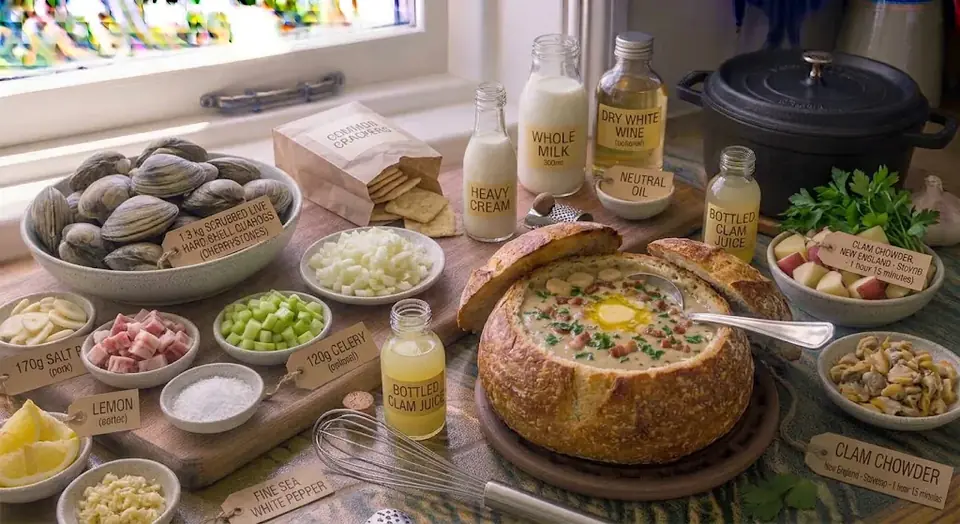
Clam Chowder in a Bread Bowl
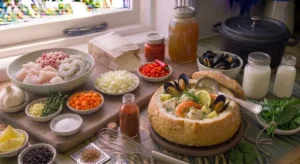
Chowder thickened for the job, poured into a toasted sourdough round.
At a glance.
Clam Chowder in a Bread Bowl comes from United States · San Francisco and appears in The Soup Atlas, in the chapter Hearty Stews & Chowders. It serves 4, takes about 1 hr 30 min, and uses 20 ingredients and 10 steps.
- Yield
- Serves 4
- Method
- Stovetop & Oven
- Time
- 1 hr 30 min
Ingredients
Tap an ingredient to tick it off.
- For the bread bowls
- For the clam base
- For the chowder
- To finish
Method
-
Steam the clams in the water in a covered pot over high heat for 5–7 minutes, pulling each one out as it opens. Discard any that refuse. Strain the liquor through damp muslin, leaving the sediment behind, chop the meat and chill it. Make the volume up to 500 ml with bottled juice.
-
Heat the oven to 190°C (375°F). Cut a lid from each loaf at a 45° angle, so the disc sits back into its own socket rather than sliding off, and set the lids aside.
-
Pull the crumb out with your fingers in large pieces, leaving a wall a full 2.5 cm (1 in) thick and a base no thinner. Hold each loaf up to the light: any translucent patch is about to become a hole at the table. Keep the crumb for croutons.
-
Brush the inside of every loaf and lid with melted butter, right into the corners, rubbing first with the cut garlic if you want it. Bake the loaves and lids on a tray for 10–12 minutes, until the interior is dry, crisp and pale gold.
-
Meanwhile, render the bacon in a cold pot brought slowly to medium heat, 8–10 minutes, until crisp. Lift it out and leave the fat. Add the butter, then the onion and celery, and sweat for 8 minutes until soft and clear.
-
Scatter in the flour and cook it for a full 2 minutes, stirring, until it smells of biscuit rather than raw paste. This chowder carries a heavier roux than the version at recipe 30, and that is deliberate — it has to hold itself up inside bread.
-
Whisk in the clam liquor a ladle at a time, letting each addition thicken before the next goes in. Add the potatoes, thyme and bay, and simmer for 12 minutes until tender, mashing a few cubes against the side.
-
Lower the heat, stir in the milk and cream, and hold the pot at a steam for 5 minutes without ever letting it bubble. It should now coat a spoon thickly and hold a channel when you draw a finger across the back of it. Add the Worcestershire, salt and pepper.
-
Return the clams and the bacon for one minute only, then take the pot off the heat. Taste again — bread is unsalted ballast and will pull the seasoning down, so this needs to read slightly bolder than a chowder served in china.
-
Set each toasted loaf on a plate, ladle the chowder in to within 2 cm of the rim, scatter parsley over and rest the lid against the side. Carry them to the table at once, with lemon and hot sauce, and eat within about fifteen minutes.
Cook’s notes
- The technique
- A bread bowl fails from the inside out, and butter is what buys you time. Melted butter soaks into the exposed crumb, and ten minutes in a hot oven drives off the surface moisture and sets a fat-saturated, water-repellent skin — the same principle as a blind-baked pastry case brushed with egg. Nothing is truly waterproof, so the second half of the defense is the chowder: a heavier roux, a lower proportion of liquid and a good crushing of potato. Thin chowder finds the crumb in about four minutes. Thick chowder sits where you put it.
- Make ahead
- The chowder base holds three days refrigerated and reheats well below a simmer, thinning slightly as it goes — hold back 100 ml of milk to correct it. The loaves can be hollowed a day ahead and kept in a paper bag, but butter and toast them within the hour you serve. A filled bread bowl cannot be made ahead by even ten minutes.
- Troubleshooting
- Leaking through the base — the wall was under an inch, or the loaf was a soft-crusted supermarket round; serve it in a shallow dish and treat the leak as gravy. Soggy rim — you filled to the top; leave 2 cm. Gluey and pasty — too much flour, or it was not cooked out; loosen with hot milk and simmer two minutes more.
- Variations
- Understand the chowder family and you can fill the loaf with any of it. Manhattan red drops the dairy for tomatoes, celery and herbs, a style linked to Portuguese and Italian cooks along the New York and Rhode Island coast. Rhode Island clear drops both dairy and tomato, leaving quahog liquor, salt pork and potato — the leanest of the three, and the local standard in South County. Providence hedges with a tomato-tinted red.
- To serve and keep
- One loaf per person, on a wide plate that will catch the inevitable. Give everyone a spoon and a napkin, put the lid alongside for dipping, and toast the reserved crumb in bacon fat as croutons for the table. Drink a cold Californian Chardonnay with no oak, or an amber ale. Made in full within this recipe — Toasted Sourdough Bowls, Clam Liquor Base, Sourdough Croutons. Also listed in the Component Index at the back.

Where it comes from
San Francisco's sourdough came in with the Gold Rush, when bakers who could keep a live starter going had an advantage over those who depended on shipped yeast; the Boudin bakery, founded in 1849, still trades on a mother dough kept in continuous use. The city's bread genuinely is distinctive — in 1971 microbiologists working on local starters described a bacterium they named Lactobacillus sanfranciscensis, and its acetic tang is the reason a San Francisco loaf tastes sharper than a Parisian one. Fisherman's Wharf grew up alongside it, worked from the late nineteenth century by Genoese and then Sicilian crews, and by the middle of the twentieth century its walk-up stands were selling crab, shrimp and chowder to visitors rather than to the fleet. The bread bowl belongs to that trade. No single inventor is documented, and rival bakeries claim it; what is certain is that it is a serving format rather than a recipe tradition, and that it changes how the chowder underneath has to be built.
Clam Chowder in a Bread Bowl: quick answers
How long does Clam Chowder in a Bread Bowl take?
About 1 hr 30 min.
How many does this Clam Chowder in a Bread Bowl recipe make?
This recipe serves 4.
Where does Clam Chowder in a Bread Bowl come from?
San Francisco's sourdough came in with the Gold Rush, when bakers who could keep a live starter going had an advantage over those who depended on shipped yeast; the Boudin bakery, founded in 1849, still trades on a mother dough kept in continuous use. The city's bread genuinely is distinctive — in 1971 microbiologists working on local starters described a bacterium they named Lactobacillus sanfranciscensis, and its acetic tang is the reason a San Francisco loaf tastes sharper than a Parisian one. Fisherman's Wharf grew up alongside it, worked from the late nineteenth century by Genoese and then Sicilian crews, and by the middle of the twentieth century its walk-up stands were selling crab, shrimp and chowder to visitors rather than to the fleet. The bread bowl belongs to that trade. No single inventor is documented, and rival bakeries claim it; what is certain is that it is a serving format rather than a recipe tradition, and that it changes how the chowder underneath has to be built.
More from United States



More in Hearty Stews & Chowders

https://www.atlasserie.com/recipes/soup/clam-chowder-in-a-bread-bowl/