Scotland · The B&B Plate · 55.95° N, 3.19° W
Scottish Breakfast
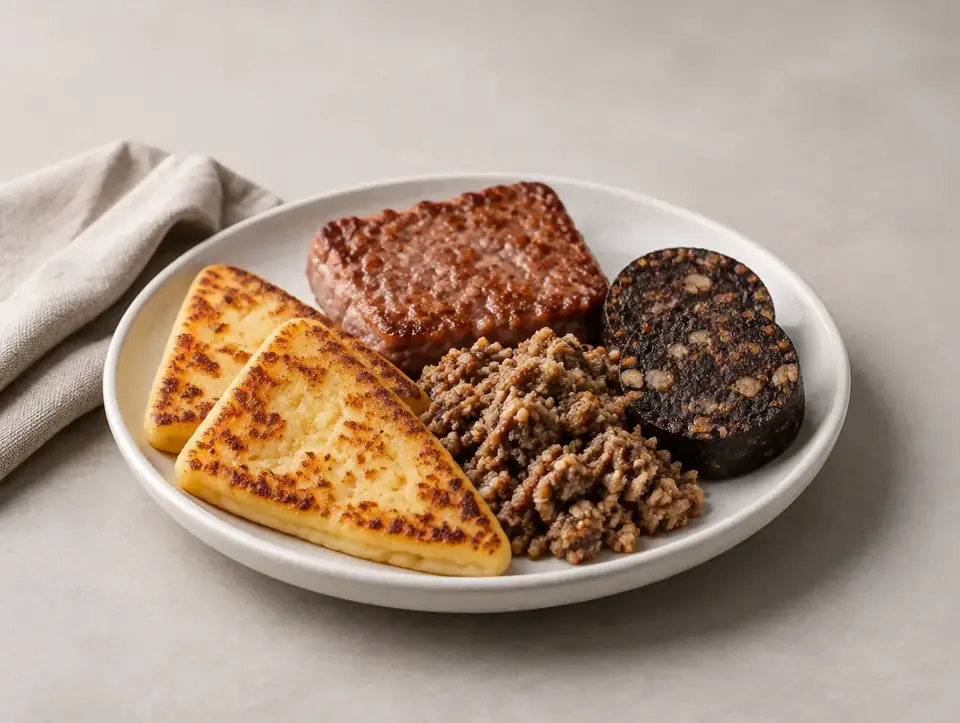
Tattie scones off the girdle, square sausage, haggis and Stornoway pudding.
At a glance.
Scottish Breakfast comes from Scotland · The B&B Plate and appears in The Breakfast Atlas, in the chapter Breakfast Around the World. It serves 2, takes about 1 hr, and uses 15 ingredients and 10 steps.
- Yield
- Serves 2
- Method
- Stovetop
- Time
- 1 hr
Ingredients
Tap an ingredient to tick it off.
- For the tattie scones (makes 8)
- For the plate
Method
-
Boil the potatoes in salted water for 18–20 minutes until a knife slides in without resistance. Drain thoroughly and leave them 2 minutes in the hot dry pan so the surface steam escapes.
-
Mash them while they are still very hot, with the butter and salt, until entirely smooth. Cold potato will not take up flour evenly, and any lump left now becomes a hard nugget in the finished scone.
-
Work in the flour and the baking powder while the mash is warm, using a light hand and stopping the moment it comes together into a soft dough. Overworking releases starch and makes the scones gluey.
-
Turn onto a floured board, divide in two and roll each half into a round about 5 mm thick. Cut each round into quarters — you should have eight farls with a clean, dry surface.
-
Cook them on a dry girdle or heavy pan over medium heat, 3 minutes a side, until dark freckles appear and the edges lift slightly. No fat at this stage; the frying happens tomorrow morning in bacon dripping.
-
For the fry, heat the dripping in a large pan over medium heat and start the Lorne sausage. Give it 4 minutes a side until well crusted; the rusk in it browns fast, so watch it more closely than a link sausage.
-
Add the haggis slices and cook them 3 minutes a side until crisp at the edges and hot through. They are fragile, so turn once with a fish slice and do not press them.
-
Lay in the bacon and cook 3–4 minutes a side. Ayrshire cure is dry and rindless, so it browns quickly and evenly and needs no trimming. Move each item to a warm plate in a 90°C oven as it finishes.
-
Fry the Stornoway black pudding 2 minutes a side — the coarse oatmeal in it goes crunchy at the edge while the middle stays soft — then the mushrooms for 4 minutes and the tomato cut-side down for 4.
-
Fry the tattie scones in the accumulated fat for 90 seconds a side until crisp and golden, then the eggs for 2–3 minutes. Assemble everything at once with hot toast and marmalade on a side plate.
Cook’s notes
- The technique
- Tattie scones need dry, hot, floury potato and as little flour as you can get away with. A waxy variety holds too much water and produces a heavy, sticky dough that needs extra flour to handle, and every extra spoonful pushes the scone toward being a plain pancake. Dry the boiled potato in the pan, mash it hot, and add flour at roughly one part to four of potato by weight, working it in for seconds rather than minutes.
- Make ahead
- Tattie scones are made to be made ahead: griddle them the night before, or up to three days in advance, and refrigerate between sheets of paper. They freeze for two months and fry straight from frozen. Slice puddings and haggis the night before. Everything else is a morning job.
- Troubleshooting
- Sticky dough that will not roll — the potatoes were waxy or under-drained; chill it for 20 minutes before adding more flour. Tough, rubbery scones — too much flour or too much kneading. Haggis crumbling into the pan — sliced too thin, or turned more than once. Lorne sausage falling apart — the pan was not hot enough to set the crust.
- Variations
- Some plates take a fried oatcake instead of the tattie scone, or alongside it. Vegetarian haggis, made with oats, pulses and plenty of pepper, is standard in Scottish cafés rather than an afterthought. Highland guest houses may offer hot-smoked salmon and scrambled eggs as the alternative, and a bowl of oatmeal ahead of the fry is a common opening.
- Serve with
- Tea, strong, or filter coffee in a hotel dining room. Toast with Dundee marmalade to close, and brown sauce on the square sausage. A dram is not breakfast, whatever visitors have been told, though a glass of cold milk with the tattie scones is entirely orthodox. Made in full within this recipe — Tattie Scones. Also listed in the Component Index at the back.

Where it comes from
The tattie scone is the item you will not find on any other fry-up, and it is exactly what its name says: cooked potato bound with a little flour, rolled thin and cooked dry on a girdle, then fried in bacon fat the next morning. It comes out of a long Scottish tradition of griddle baking — bannocks, oatcakes, drop scones — in a country where domestic ovens arrived late. Around it sits a specific cast of characters. Lorne sausage is a square slice cut from a beef-and-rusk loaf, a Glasgow product whose name is variously attributed to the Marquis of Lorne and to a music hall, with no settled evidence for either. Haggis appears sliced and fried, treated as an everyday breakfast meat rather than a Burns Night ceremony. Black pudding from Stornoway on the Isle of Lewis, coarse and heavily peppered, gained protected geographical status in 2013. The whole assembly was consolidated by tourism: the guest house and B&B breakfast, cooked to order and served with toast and marmalade, is where most people first meet it.
Scottish Breakfast: quick answers
How long does Scottish Breakfast take?
About 1 hr.
How many does this Scottish Breakfast recipe make?
This recipe serves 2.
Where does Scottish Breakfast come from?
The tattie scone is the item you will not find on any other fry-up, and it is exactly what its name says: cooked potato bound with a little flour, rolled thin and cooked dry on a girdle, then fried in bacon fat the next morning. It comes out of a long Scottish tradition of griddle baking — bannocks, oatcakes, drop scones — in a country where domestic ovens arrived late. Around it sits a specific cast of characters. Lorne sausage is a square slice cut from a beef-and-rusk loaf, a Glasgow product whose name is variously attributed to the Marquis of Lorne and to a music hall, with no settled evidence for either. Haggis appears sliced and fried, treated as an everyday breakfast meat rather than a Burns Night ceremony. Black pudding from Stornoway on the Isle of Lewis, coarse and heavily peppered, gained protected geographical status in 2013. The whole assembly was consolidated by tourism: the guest house and B&B breakfast, cooked to order and served with toast and marmalade, is where most people first meet it.
More from United Kingdom
More in Breakfast Around the World


https://www.atlasserie.com/recipes/breakfast/scottish-breakfast/