Switzerland · Zurich, c. 1900 · 46.79° N, 8.12° E
Bircher Muesli
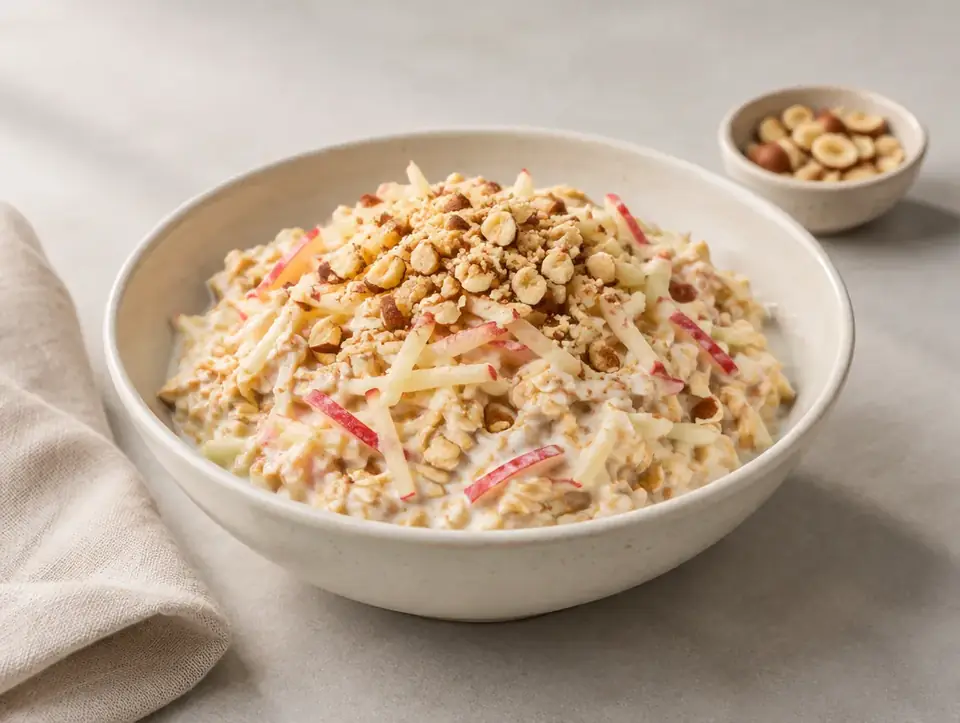
The original apple-led formula: grated apple, lemon, soaked oats, ground nuts.
At a glance.
Bircher Muesli comes from Switzerland · Zurich, c. 1900 and appears in The Breakfast Atlas, in the chapter Oats, Grains & Porridge. It serves 2, takes about 12 hr 15 min, and uses 10 ingredients and 9 steps.
- Yield
- Serves 2
- Method
- No-cook
- Time
- 12 hr 15 min
Ingredients
Tap an ingredient to tick it off.
- For the overnight soak
- For the Bircher base
- To assemble
Method
-
The night before, stir the oats, cold water and salt together, cover and refrigerate twelve hours. Water, not milk — the original soak is deliberately plain so the apple carries all the flavor.
-
In the morning, toast the ground nuts in a dry pan over low heat for three minutes until they smell warm, then tip them onto a cold plate. Bircher-Benner used them raw.
-
Whisk the lemon juice, condensed milk and cold water into the soaked oats until the mixture is smooth and loose enough to pour slowly from the back of a spoon.
-
Taste it now, before the apple goes in. It should be sharply lemony and almost too sweet, because the fruit will dilute both within a minute of grating.
-
Set a coarse box grater over the bowl and have everything else ready. From here the clock is running, since grated apple browns in about two minutes.
-
Grate the apples straight into the mixture, skin and all, turning the fruit as you go. Bircher-Benner grated the whole apple including the core; grate down to the pips and discard the stalk.
-
Stir at once so the lemon juice coats every shred. The acid blocks polyphenol oxidase, the enzyme that browns cut apple, but only where it actually makes contact.
-
Check the balance. It should look like grated apple bound with a little oat cream, not porridge with apple in it; if it looks like porridge, grate in another apple.
-
Divide between two bowls, spoon over the crème fraîche, scatter the ground nuts thickly across the surface and add the raspberries. Serve within ten minutes, while the apple is pale and crisp.
Cook’s notes
- The technique
- The lemon is not a flavoring, or not only. Cut apple browns because polyphenol oxidase in the flesh reacts with oxygen; acid drops the pH below the enzyme's working range and stops it. That is why the juice goes into the base before the apple is grated rather than being squeezed over afterwards. Grate coarsely too, since fine grating ruptures more cells and gives a wet, pulpy bowl.
- Make ahead
- Only the oat soak can be done ahead, and it must be: twelve hours in the refrigerator. The lemon and condensed milk base can be whisked the night before and kept covered. The apple cannot be prepared in advance under any circumstances, since it browns and weeps.
- Troubleshooting
- Brown, oxidized apple — grated before the acid was in the bowl, or left standing. Watery pool at the base — the apples were over-ripe or grated too fine; use a firm tart variety. Cloying — condensed milk without enough lemon, so add another half lemon rather than more fruit.
- Variations
- The cream version replaces condensed milk with lightly whipped double cream and honey. The modern café Bircher inverts the ratio entirely: 100 g oats soaked in 200 ml milk with 100 g yogurt and one grated apple. A dairy-free reading soaks the oats in apple juice and binds with thinned almond butter.
- Serve with
- Serve as a first course rather than a whole breakfast, as the sanatorium did, followed by bread and cheese. Milky coffee or cold apple juice suits it. A second bowl of ground nuts lets people add more, which they will.

Where it comes from
Maximilian Oskar Bircher-Benner (1867–1939) was a Zurich physician convinced that raw plant food carried a vital energy cooking destroyed — a theory his contemporaries rejected and which has not aged well. His sanatorium, Lebendige Kraft, opened on the Zürichberg above Zurich in 1904, and the dish he served his patients was called d'Spys, the food, or Apfeldiätspeise, the apple diet dish. The often-repeated story that he learned it from an Alpine shepherd is told everywhere and documented almost nowhere; treat it with caution. What is well recorded is the formula, and it startles a modern reader. One tablespoon of oats, soaked twelve hours in three tablespoons of water. The juice of half a lemon. A tablespoon of sweetened condensed milk. One large apple grated whole into the bowl at the last second, core and all. A tablespoon of ground hazelnuts over the top. Apple is the dish and oats are the garnish. The modern café version has drifted the other way entirely, oat-heavy and yogurt-based, which is a fine breakfast but a different one.
Bircher Muesli: quick answers
How long does Bircher Muesli take?
About 12 hr 15 min.
How many does this Bircher Muesli recipe make?
This recipe serves 2.
Where does Bircher Muesli come from?
Maximilian Oskar Bircher-Benner (1867–1939) was a Zurich physician convinced that raw plant food carried a vital energy cooking destroyed — a theory his contemporaries rejected and which has not aged well. His sanatorium, Lebendige Kraft, opened on the Zürichberg above Zurich in 1904, and the dish he served his patients was called d'Spys, the food, or Apfeldiätspeise, the apple diet dish. The often-repeated story that he learned it from an Alpine shepherd is told everywhere and documented almost nowhere; treat it with caution. What is well recorded is the formula, and it startles a modern reader. One tablespoon of oats, soaked twelve hours in three tablespoons of water. The juice of half a lemon. A tablespoon of sweetened condensed milk. One large apple grated whole into the bowl at the last second, core and all. A tablespoon of ground hazelnuts over the top. Apple is the dish and oats are the garnish. The modern café version has drifted the other way entirely, oat-heavy and yogurt-based, which is a fine breakfast but a different one.
More in Oats, Grains & Porridge


https://www.atlasserie.com/recipes/breakfast/bircher-muesli/