United States · The Bundt Pan · 39.87° N, 98.73° W
Monkey Bread
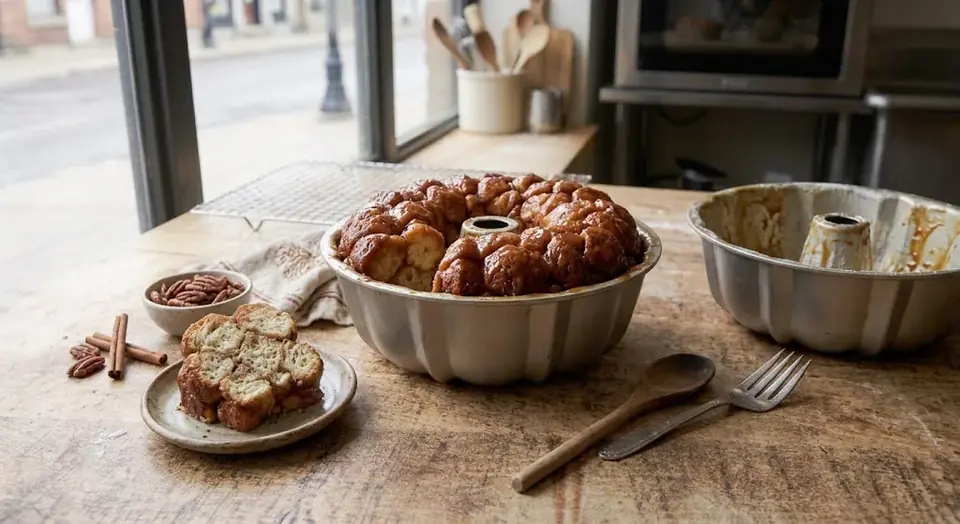
Dough balls rolled in cinnamon sugar under a butterscotch flood.
At a glance.
Monkey Bread comes from United States · The Bundt Pan and appears in The Bread Atlas, in the chapter Sweet & Enriched Breads. It serves 8, is made by oven 180°c / 350°f, and uses 14 ingredients and 11 steps.
- Yield
- Serves 8
- Method
- Oven 180°C / 350°F, 3½ hours
Ingredients
Tap an ingredient to tick it off.
- The Dough
- Cinnamon Sugar Coating
- Butterscotch Caramel
Method
-
Mix the flour, sugar, salt and yeast with milk at 24°C and the beaten egg to a rough dough, rest 20 minutes, then knead 8 minutes. Add the soft butter in two additions and knead to a full windowpane. This dough is leaner than the rolls in this chapter because the coating carries so much fat and sugar.
-
Bulk ferment 75 minutes at 25°C until doubled. Butter a 24 cm Bundt tin obsessively — into every flute, up the central funnel, and over the rim — then dust it with flour and knock out the excess. Caramel finds any patch you miss.
-
Make the butterscotch: melt the butter with the dark brown sugar over low heat, stir in the cream and salt, and simmer 2 minutes until glossy and slightly thickened. Take it off the heat, add the vanilla, and let it cool to lukewarm.
-
Combine the light brown sugar and cinnamon in a wide bowl, and put the melted butter for dipping in another. Set both beside the tin along with a small bowl of water for your hands — this stage is unavoidably sticky.
-
Turn the dough out and divide it into roughly 40 pieces of about 22 g, using a scraper and the scale rather than the eye. Uniform pieces bake evenly; a mixture of large and small gives raw centers next to dry ones.
-
Roll each piece into a smooth ball between cupped palms, without flour. A taut skin holds the coating; a ragged piece sheds it into the caramel.
-
Dip each ball in melted butter, let the excess run off, then turn it in the cinnamon sugar until fully coated. Do them in batches of six or the sugar clumps into paste as the butter accumulates.
-
Layer the balls into the tin, spacing them loosely and staggering the joins between layers so the finished loaf holds together in a brickwork pattern. Spoon a third of the butterscotch over each of the three layers as you build.
-
Cover and prove 45–60 minutes at 24°C, until the balls have grown into each other and the dough has reached about 2 cm below the rim. Do not let it rise to the top — the caramel boils up during the bake and needs the headroom.
-
Heat the oven to 180°C / 350°F, set the tin on a lined tray to catch the overflow, and bake 33–38 minutes, until the top is deep brown, the caramel is bubbling around the edge, and a skewer pushed to the center meets no raw dough at 90°C.
-
Cool 8 minutes exactly, then lay a plate over the tin and invert. Leave the tin in place for a further minute so the caramel drains down over the loaf, then lift it off. Serve hot, pulled apart with fingers.
Cook’s notes
- To serve and keep
- Set the whole thing hot in the middle of the table and let everyone pull pieces off; plates are optional, napkins are not. It belongs to Christmas morning, brunch and children's birthdays. It does not keep and is not meant to — anything left over should be reheated the same day.

Where it comes from
Two threads meet in this pan. The first is the pan itself: H. David Dalquist of Nordic Ware produced the aluminium Bundt in Minneapolis in 1950, at the request of local Hadassah Society members who wanted a lighter version of the heavy cast-iron Bundkuchen and kugelhopf moulds their families had baked in; it sold modestly until a Bundt-baked Tunnel of Fudge cake placed at the 1966 Pillsbury Bake-Off, after which it became the most common decorative tin in America. The second thread is the recipe, and it is older than the pan. Aranygaluska, the Hungarian golden dumpling — balls of yeast dough rolled in butter and sugared nuts and baked pressed together — reached American kitchens through Hungarian and Hungarian-Jewish households, and mid-century newspaper columns printed it as Hungarian coffee cake in terms almost identical to modern monkey bread. Recipes under the monkey name appear from the 1940s and 1950s onward, and Nancy Reagan's version circulated widely in the 1980s. Where the name came from, nobody can say; every explanation offered is a guess.
Monkey Bread: quick answers
How many does this Monkey Bread recipe make?
This recipe serves 8.
Where does Monkey Bread come from?
Two threads meet in this pan. The first is the pan itself: H. David Dalquist of Nordic Ware produced the aluminium Bundt in Minneapolis in 1950, at the request of local Hadassah Society members who wanted a lighter version of the heavy cast-iron Bundkuchen and kugelhopf moulds their families had baked in; it sold modestly until a Bundt-baked Tunnel of Fudge cake placed at the 1966 Pillsbury Bake-Off, after which it became the most common decorative tin in America. The second thread is the recipe, and it is older than the pan. Aranygaluska, the Hungarian golden dumpling — balls of yeast dough rolled in butter and sugared nuts and baked pressed together — reached American kitchens through Hungarian and Hungarian-Jewish households, and mid-century newspaper columns printed it as Hungarian coffee cake in terms almost identical to modern monkey bread. Recipes under the monkey name appear from the 1940s and 1950s onward, and Nancy Reagan's version circulated widely in the 1980s. Where the name came from, nobody can say; every explanation offered is a guess.
More from United States



More in Sweet & Enriched Breads
https://www.atlasserie.com/recipes/bread/monkey-bread/