The Breakfast Atlas
Overnight Oats
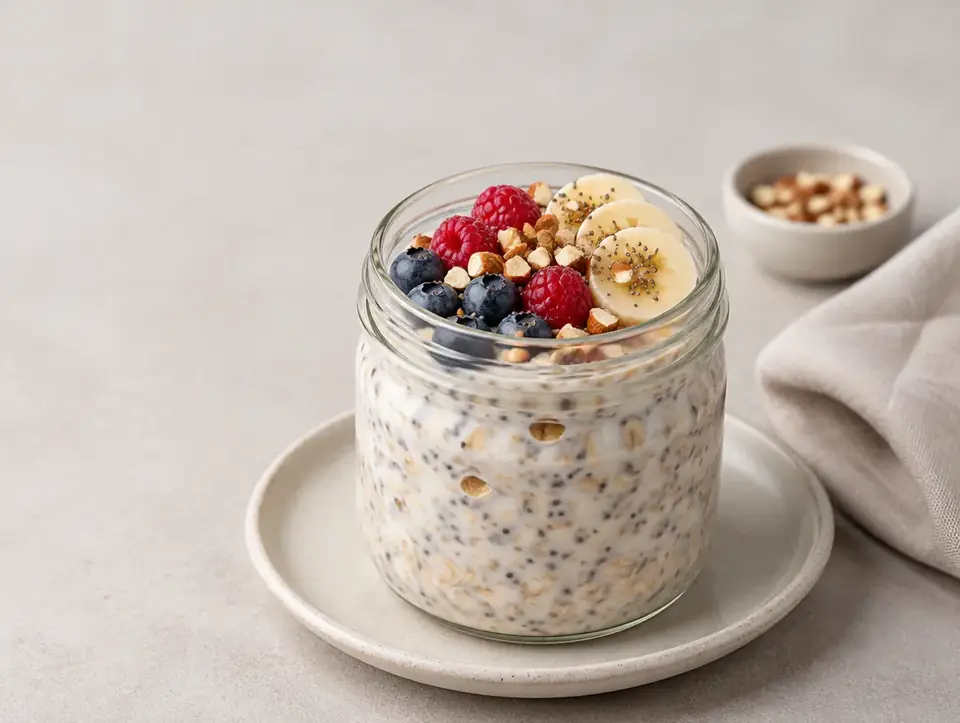
A cold jar of oats softened overnight, thickened with chia and yogurt.
At a glance.
Overnight Oats is a recipe from The Breakfast Atlas, in the chapter Oats, Grains & Porridge. It serves 2, takes about 8 hr 10 min, and uses 11 ingredients and 8 steps.
- Yield
- Serves 2
- Method
- No-cook
- Time
- 8 hr 10 min
Ingredients
Tap an ingredient to tick it off.
- To finish
Method
-
Choose two jars of about 400 ml with lids that seal. Wide-mouthed jars are worth seeking out, because a narrow neck makes stirring in the morning genuinely awkward.
-
Whisk the milk, yogurt, maple syrup, vanilla and salt in a jug until no streaks of yogurt remain. Combining the wet ingredients first stops the yogurt setting in lumps against dry oats.
-
Stir the chia into the liquid, leave it two minutes, then stir again. Chia clumps the instant it meets liquid and stays clumped unless it is disturbed twice.
-
Divide the oats between the jars, roughly 90 g each, and pour the liquid over. Aim for equal volumes of oats and liquid; the yogurt and chia supply the extra thickening.
-
Stir each jar thoroughly with a long spoon, reaching the bottom corners where dry oats collect. Every flake needs contact with liquid or it stays chalky in the middle.
-
Seal and refrigerate at least eight hours and up to five days. Keep the refrigerator at or below 4°C; nothing here is cooked, so cold is the only control on spoilage.
-
By morning the mixture will be thick and slightly domed. Stir hard to break the set, then add extra milk a tablespoon at a time until it falls slowly from the spoon.
-
Taste and adjust, since cold blunts sweetness. Top with berries, seeds and a swirl of loosened nut butter and eat from the jar; fruit added now will not bleed color through the oats.
Cook’s notes
- The technique
- The ratio decides everything. Equal volumes of oats and liquid, one to one, give a spoonable jar; anything drier sets into paste, anything wetter never holds. Chia is the correction mechanism — each seed absorbs roughly ten times its weight in water and wraps itself in mucilage, so a single extra tablespoon rescues a loose batch overnight. Stir it in twice, two minutes apart, or it sets as gravel.
- Make ahead
- Make-ahead by definition. Build up to five jars at once and hold them at 4°C or below; they are best on days one to three and edible through day five. Do not freeze — the yogurt separates and the oats go grainy on thawing.
- Troubleshooting
- Chalky centers — under-stirred, so dry oats stayed dry; reach the bottom before sealing. Gritty lumps — chia was added dry to the oats rather than hydrated in the liquid first. Sour or fizzy smell — discard the jar rather than tasting it, since uncooked dairy in a warm refrigerator turns fast.
- Variations
- A dairy-free jar uses coconut yogurt and almond milk with an extra teaspoon of chia to offset the thinner liquid. Carrot cake oats add 60 g grated carrot, 1 tsp cinnamon and 2 tbsp raisins. A higher-protein version whisks 25 g vanilla whey or pea protein into the liquid, with 60 ml more milk.
- Serve with
- Eat cold from the jar, with strong coffee or a green tea. Nothing needs to be served alongside; if this is breakfast at a desk, pack the seeds and fruit separately so they stay crisp.
Where it comes from
This is the newest dish in the chapter and the only one with no village of origin. Cold-soaked oats descend distantly from Swiss practice, but the jar as we know it — oats, milk, yogurt and chia in a screw-top, left in the refrigerator — belongs to the 2010s, to food blogs, office kitchens and the meal-prep culture that grew up around social media and shift work. Its rise tracked two things: the wide availability of chia seeds in Western supermarkets after about 2005, and the arrival of strained Greek-style yogurt as a mainstream product. Where the sanatorium version was assembled at the table, this one is built on a Sunday night in a row of identical jars. The trade-off is honest. Cold soaking gives a softer, milder, more custardy bowl than any cooked porridge, because the starch never gelatinizes; it only swells.
Overnight Oats: quick answers
How long does Overnight Oats take?
About 8 hr 10 min.
How many does this Overnight Oats recipe make?
This recipe serves 2.
Where does Overnight Oats come from?
This is the newest dish in the chapter and the only one with no village of origin. Cold-soaked oats descend distantly from Swiss practice, but the jar as we know it — oats, milk, yogurt and chia in a screw-top, left in the refrigerator — belongs to the 2010s, to food blogs, office kitchens and the meal-prep culture that grew up around social media and shift work. Its rise tracked two things: the wide availability of chia seeds in Western supermarkets after about 2005, and the arrival of strained Greek-style yogurt as a mainstream product. Where the sanatorium version was assembled at the table, this one is built on a Sunday night in a row of identical jars. The trade-off is honest. Cold soaking gives a softer, milder, more custardy bowl than any cooked porridge, because the starch never gelatinizes; it only swells.
More in Oats, Grains & Porridge


https://www.atlasserie.com/recipes/breakfast/overnight-oats/