United States · Louisiana · 39.87° N, 98.73° W
Gumbo
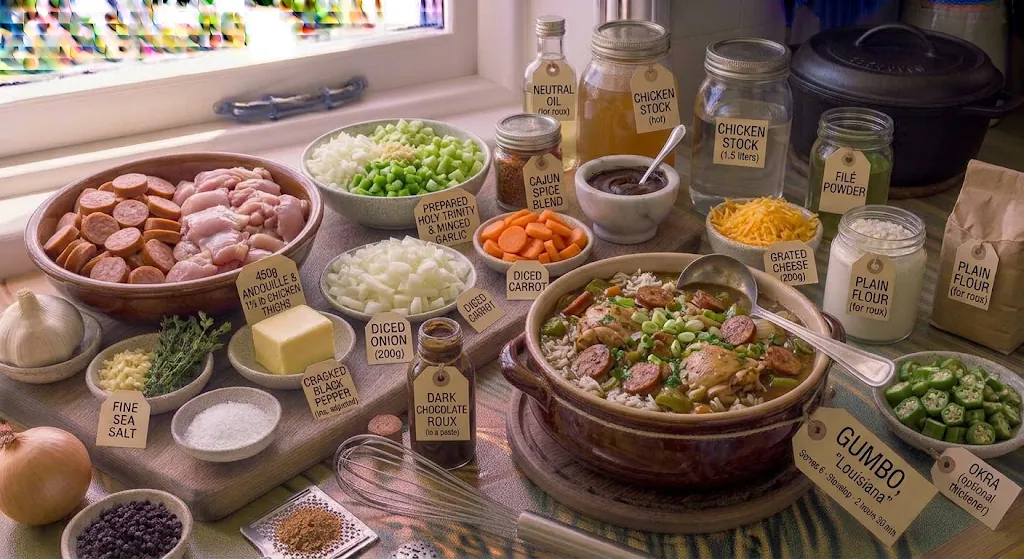
A roux taken to dark chocolate, the trinity, andouille and chicken over rice.
At a glance.
Gumbo comes from United States · Louisiana and appears in The Soup Atlas, in the chapter Hearty Stews & Chowders. It serves 6, takes about 2 hr 30 min, and uses 18 ingredients and 10 steps.
- Yield
- Serves 6
- Method
- Stovetop
- Time
- 2 hr 30 min
Ingredients
Tap an ingredient to tick it off.
- For the dark roux
- For the holy trinity
- For the pot
- For the thickener — choose one
- To serve
Method
-
Prepare everything first. Chop the trinity into one bowl, slice the sausage, cut the chicken, measure the spices and heat the stock. Once the roux begins you cannot leave the stove for forty-five minutes, and there is no pausing it.
-
Take the heat seriously. A dark roux runs well above 180°C (355°F) and sticks to skin — cooks call it Cajun napalm without much humor. Use a heavy pot with high sides and a long-handled flat spoon, wear closed shoes, and keep children and pets out of the kitchen.
-
Warm the oil in the pot over medium-low heat and whisk in the flour until there are no lumps. Then switch to the flat spoon and stir continuously, reaching into the corners of the pot where scorching begins. Do not raise the heat to hurry it.
-
Over the next 45 minutes it will pass through blond, then the color of peanut butter, then milk chocolate, then a dark, glossy chestnut. The smell changes with it, from raw flour to popcorn to toasted nuts. Keep stirring the entire time; thirty seconds of neglect is enough.
-
Stop at dark chocolate. Past that point the roux is burning rather than browning, and black flecks or an acrid, ashy smell mean it is finished — throw it out, wash the pot and start again, because burnt roux cannot be diluted, sweetened or corrected, and it will make eight servings inedible.
-
Tip in the entire bowl of trinity at once and stir hard. The cold vegetables drop the temperature immediately, which is what stops the roux dead, and the pot will hiss and steam violently. Stand back as you add them. Cook for 8 minutes until they soften.
-
Add the garlic and the spice mix and stir for 1 minute, then the andouille, turning it through the roux for 3 minutes until it starts to release its fat and color the paste.
-
Pour in the hot stock a ladleful at a time, stirring each addition into a smooth paste before adding more. Cold stock into hot roux seizes into lumps; hot stock and patience give you a smooth, deep-brown liquid. Add the bay and thyme.
-
Bring it to a low simmer and cook uncovered for 45 minutes, skimming the oil that rises — a gumbo throws a good deal, and taking most of it off is the difference between rich and greasy. Add the chicken for the last 20 minutes, until cooked through to 74°C (165°F).
-
Take the pot off the heat, season with salt, and stir in the filé if you are using it — boiled filé turns stringy and ropey, so it goes in at the end or at the table, never during cooking. Serve over steamed rice with scallions, parsley and hot sauce.
Cook’s notes
- The technique
- The roux is doing two contradictory jobs. Heating flour breaks its starch chains down into smaller fragments, which builds flavor through browning but destroys thickening power — a dark roux thickens perhaps a quarter as much as a blond one, which is why gumbo uses half a cup of flour for a pot this size and still runs looser than a stew. What forty-five minutes buys is roasted, nutty, faintly bitter depth that nothing else supplies. The three thickeners are alternatives with histories: fried okra, filé off the heat, roux for color and flavor. Cooks combine them freely.
- Make ahead
- Gumbo is better on day two and holds four days refrigerated and three months frozen. Freeze it without rice. Make the roux ahead in a double batch if you like — it keeps a month in a sealed jar in the fridge, with the oil separating on top, and stirs back in fine. Reheat gently and add filé fresh each time, since it does not survive a second boil.
- Troubleshooting
- Acrid and bitter, with black specks — the roux burned; there is no rescue and the whole pot must be started again. Lumpy — cold stock went into hot roux, or it went in too fast; a stick blender will smooth it. Thin — that is normal, but simmer another twenty minutes uncovered. Ropey and slick — filé was boiled. Greasy — skim more, or chill and lift the cap.
- Variations
- Gumbo z'herbes is the meatless Lenten version built on seven or more greens. Seafood gumbo swaps the chicken for shrimp, crab and oysters added in the last five minutes, and usually runs on a lighter roux. Creole gumbo in the city adds tomatoes and often okra. Chicken and andouille, as here, is the country Cajun standard.
- To serve and keep
- Ladle over a scoop of steamed white rice pressed into the center of a shallow bowl, so the rice sits as an island rather than a bed. Potato salad on the side is a genuine Louisiana habit, not a joke. Drink cold lager, or sweet tea. Made in full within this recipe — Dark Roux, Holy Trinity, Chicken Stock, Steamed Rice. Also listed in the Component Index at the back.

Where it comes from
Gumbo is the clearest edible record of who built Louisiana. Okra came with enslaved West Africans, along with the practice of thickening a stew with it; the dish's name almost certainly follows the same route, from words like ki ngombo and quingombo for okra in Bantu languages. Filé, powdered dried sassafras leaf, is Choctaw, adopted from the Indigenous people of the region and still sold at markets by their descendants. The roux is French technique pushed far past any French intention. Spanish colonial administration and Caribbean arrivals contributed the seasoning habits and the rice. The dish appears in Louisiana accounts from the early nineteenth century — one much-quoted description of a 1803 gathering in New Orleans mentions two dozen gumbos on the table — and it was codified in print in Creole cookbooks by the 1880s. Louisiana named it the official state cuisine in 2004. Creole gumbo in New Orleans tends to include tomatoes and seafood; Cajun gumbo in the country parishes goes darker, hotter and without tomato, which is the version here.
Gumbo: quick answers
How long does Gumbo take?
About 2 hr 30 min.
How many does this Gumbo recipe make?
This recipe serves 6.
Where does Gumbo come from?
Gumbo is the clearest edible record of who built Louisiana. Okra came with enslaved West Africans, along with the practice of thickening a stew with it; the dish's name almost certainly follows the same route, from words like ki ngombo and quingombo for okra in Bantu languages. Filé, powdered dried sassafras leaf, is Choctaw, adopted from the Indigenous people of the region and still sold at markets by their descendants. The roux is French technique pushed far past any French intention. Spanish colonial administration and Caribbean arrivals contributed the seasoning habits and the rice. The dish appears in Louisiana accounts from the early nineteenth century — one much-quoted description of a 1803 gathering in New Orleans mentions two dozen gumbos on the table — and it was codified in print in Creole cookbooks by the 1880s. Louisiana named it the official state cuisine in 2004. Creole gumbo in New Orleans tends to include tomatoes and seafood; Cajun gumbo in the country parishes goes darker, hotter and without tomato, which is the version here.
The same dish in another volume

More from United States






More in Hearty Stews & Chowders



https://www.atlasserie.com/recipes/soup/gumbo-soup/