France · Paris and Les Halles · 46.56° N, 2.35° E
French Onion Soup
An hour of onions in butter, beef stock, and a lid of molten Gruyère.
At a glance.
French Onion Soup comes from France · Paris and Les Halles and appears in The Soup Atlas, in the chapter Classic & Everyday Soups. It serves 4, takes about 5 hr 30 min, and uses 21 ingredients and 11 steps.
- Yield
- Serves 4
- Method
- Stovetop & Oven
- Time
- 5 hr 30 min
Ingredients
Tap an ingredient to tick it off.
- For the beef stock
- For the onions
- For the pot
- For the gratinée
Method
-
Make the stock a day ahead if you can. Heat the oven to 220°C (425°F), spread the bones in a roasting tin and roast for 40 minutes, then smear them with the tomato paste, add the onion, carrot and celery and roast 20 minutes more, until everything is mahogany.
-
Tip it all into a tall pot, deglaze the tin with water and add that too, then cover with the cold water and add the bay, thyme and peppercorns. Bring to a bare simmer, skim, and hold it there for 4 hours. Strain, chill, and lift off the set fat.
-
A carton beef stock will get you through and it costs you real body, since it carries almost no gelatin and often leans on yeast extract for savor. If you use one, soften a teaspoon of powdered gelatin into it to restore some of the mouthfeel.
-
Slice the onions with the grain, root to tip, rather than across; cut this way they hold together through the long cooking instead of falling to threads. You will need what looks like an absurd quantity, because they lose around three-quarters of their volume.
-
Melt the butter with the oil in a wide, heavy pot over medium heat, add the onions with the salt and sugar, and cover for the first 15 minutes. They will collapse and flood the pot with their own liquid, which is the water that has to leave before browning can start.
-
Uncover and cook over medium-low heat for a further 45–60 minutes, stirring every few minutes and scraping the base with a flat wooden spoon. They will pass through white, to soft and translucent, to gold, and finally to a dark, jammy mahogany.
-
There is no shortcut and no ten-minute version. When the base browns and threatens to catch, add a splash of water and scrape it clean; that sticky residue is concentrated sugar and it belongs in the pot, not welded to the metal.
-
Stir the flour through the onions and cook it out for 2 minutes, then pour in the sherry and let it bubble down to almost nothing, scraping constantly. The flour is not there to thicken so much as to stop the finished soup separating in the bowl.
-
Add the stock, bay and thyme, bring to a gentle simmer and cook uncovered for 40 minutes. Fish out the herbs, add the vinegar, and season carefully — reduced beef stock is already savory and it is easy to go too far.
-
Toast the baguette slices until dry and hard on both sides and rub one face of each with the cut garlic. Dry toast matters: soft bread turns to sludge under the cheese within a minute of hitting the soup.
-
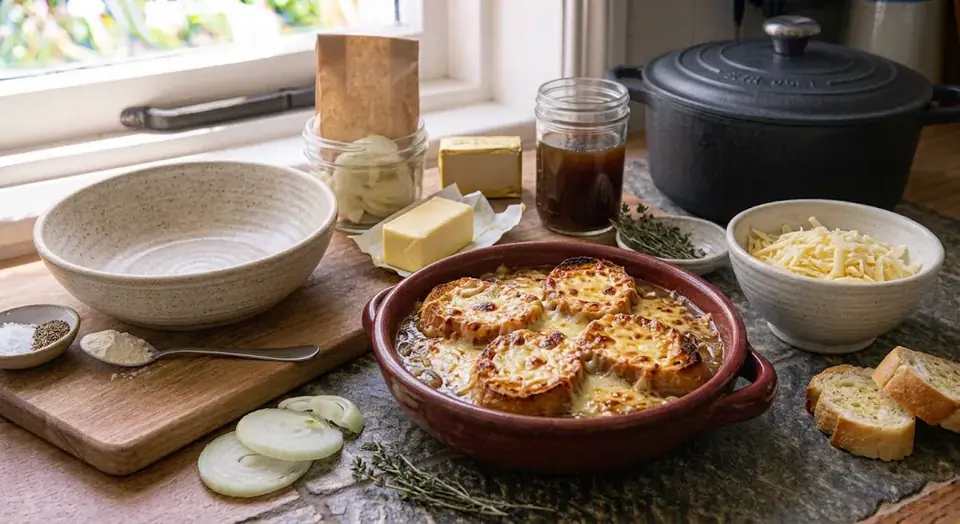
Ladle the soup into ovenproof crocks set on a tray, leaving 3 cm of clearance. Float two toasts on each, pile the mixed cheeses over them and out to the rim so they seal the surface, and grill 10 cm from the element for 4–6 minutes, until molten, blistered and browned at the edges.
Cook’s notes
- The technique
- Onions are around 89 percent water and only 1.5 to 2 percent sugar, and neither browning reaction can begin until most of that water has gone. What follows is two processes at once: caramelization of the onion's own fructose and glucose, and Maillard browning between those sugars and the onion's amino acids, while the harsh sulfur compounds that make raw onion pungent break down into sweeter-tasting ones. All of it takes 45 to 60 minutes over medium-low heat, and recipes promising it in ten are measuring something else. A pinch of baking soda genuinely speeds browning by raising the pH, but it costs you the texture — the onions turn to mush — and leaves a faintly soapy note.
- Make ahead
- The stock is a separate project and keeps five days refrigerated, six months frozen. The onion base is better made a day ahead and improves in the fridge for up to four days; it also freezes for three months, so cook double. Assemble and grill only at the moment of serving. A gratinée that has stood goes rubbery on top and waterlogged beneath, and no reheating brings it back.
- Troubleshooting
- Sweet but thin — the onions were taken only to gold, not mahogany. Bitter and acrid — the heat was too high and the sugars scorched rather than caramelized; there is no fix. Soup separated in the bowl — the flour step was skipped. Bread sunk to the bottom — it was not toasted dry enough. Cheese oily rather than stringy — pre-grated cheese with anti-caking starch, or the grill was too close.
- Variations
- Soupe à l'oignon gratinée is the version here; served without the cheese lid it is plain soupe à l'oignon and considerably lighter. Lyonnais cooks sometimes whisk an egg yolk with a little port and stir it under the crust at the table. A vegetarian pot built on a dark mushroom and roasted-onion stock with a spoonful of soy is a genuine soup rather than an apology, though it will never be the same soup.
- To serve and keep
- Serve in lion's-head crocks or any straight-sided ovenproof bowl, set on a plate — they come out at 200°C and stay hot for a long time. Warn people. Drink what deglazed it: dry sherry, or a Burgundy-region white with enough acidity to cut the cheese. Made in full within this recipe — Roasted Beef Stock, Caramelized Onion Base, Gruyère Gratinée. Also listed in the Component Index at the back.

Where it comes from
Onion soup begins as food for people with onions and not much else — the Romans ate versions of it, and it stayed peasant cooking across France for centuries. Its modern form belongs to Paris, and specifically to Les Halles, the vast central market rebuilt in iron and glass by Victor Baltard from the 1850s and christened the belly of Paris by Émile Zola in his novel of 1873. The porters worked through the night, and the bistros around the market fed them onion soup under a raft of bread and cheese in the small hours; theatre-goers and revellers on their way home ate the same bowl for the same reason. When the market moved to Rungis in 1969 and the pavilions came down in 1971, the soup had already outlived its original constituency. The tale that Louis XV improvised it at a hunting lodge from onions, butter and champagne is folklore with no contemporary source. The gratinée, meanwhile, reached American kitchens largely through Julia Child, whose 1961 Mastering the Art of French Cooking opens its soup chapter with it.
French Onion Soup: quick answers
How long does French Onion Soup take?
About 5 hr 30 min.
How many does this French Onion Soup recipe make?
This recipe serves 4.
Where does French Onion Soup come from?
Onion soup begins as food for people with onions and not much else — the Romans ate versions of it, and it stayed peasant cooking across France for centuries. Its modern form belongs to Paris, and specifically to Les Halles, the vast central market rebuilt in iron and glass by Victor Baltard from the 1850s and christened the belly of Paris by Émile Zola in his novel of 1873. The porters worked through the night, and the bistros around the market fed them onion soup under a raft of bread and cheese in the small hours; theatre-goers and revellers on their way home ate the same bowl for the same reason. When the market moved to Rungis in 1969 and the pavilions came down in 1971, the soup had already outlived its original constituency. The tale that Louis XV improvised it at a hunting lodge from onions, butter and champagne is folklore with no contemporary source. The gratinée, meanwhile, reached American kitchens largely through Julia Child, whose 1961 Mastering the Art of French Cooking opens its soup chapter with it.
The same dish in another volume

More from France






More in Classic & Everyday Soups





https://www.atlasserie.com/recipes/soup/french-onion-soup/