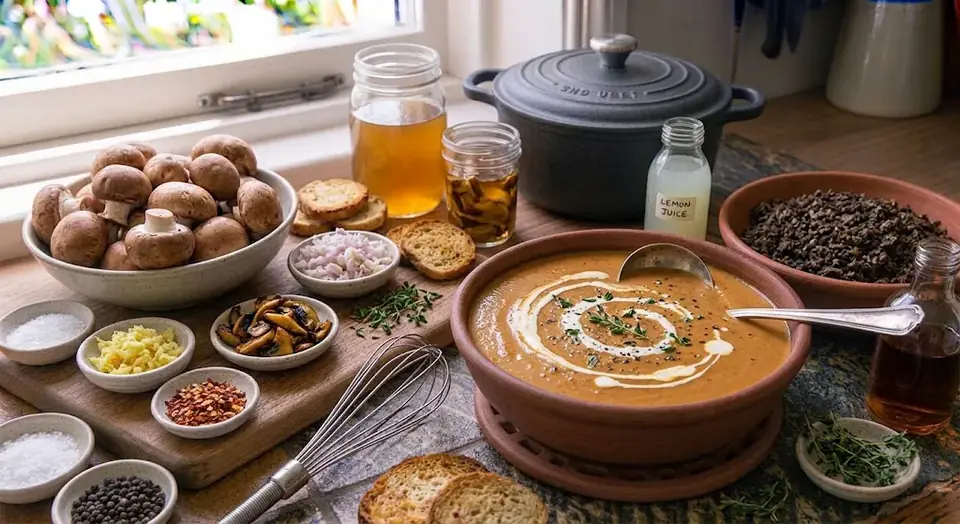
France · Duxelles and Velouté · 46.56° N, 2.35° E
Cream of Mushroom
A proper velouté built on duxelles, dry-browned mushrooms and porcini liquor.
At a glance.
Cream of Mushroom comes from France · Duxelles and Velouté and appears in The Soup Atlas, in the chapter Classic & Everyday Soups. It serves 6, takes about 1 hr 15 min, and uses 21 ingredients and 11 steps.
- Yield
- Serves 6
- Method
- Stovetop
- Time
- 1 hr 15 min
Ingredients
Tap an ingredient to tick it off.
- For the porcini liquor
- For the dry-sautéed mushrooms
- For the duxelles
- For the velouté
- To finish
Method
-
Cover the dried porcini with the boiling water and leave them 20 minutes. Lift them out, chop them finely, and pour the soaking liquid through a coffee filter or a doubled sheet of muslin, leaving the last spoonful with its grit behind in the cup.
-
Set a wide pan over medium-high heat with no fat in it at all and add the sliced mushrooms in a single layer, working in two batches if you have to. They will squeak, then release a startling amount of water and sit in it.
-
Keep going, stirring occasionally, for 8–10 minutes, until every drop of that liquid has boiled away and you hear the pan change note from a simmer to a sizzle. Only then add the 30 g of butter and the salt, and brown them for 4–5 minutes until deep gold at the edges.
-
Mushrooms are over ninety percent water. Add fat while they are still wet and they poach in their own liquid, staying pale, squeaky and rubbery, and no later step recovers what that costs. Set the browned slices aside.
-
In the same pan, melt the duxelles butter and add the shallots. Cook for 3 minutes until soft, then add the finely chopped mushrooms, the thyme leaves and the half-teaspoon of salt.
-
Cook the duxelles over medium heat for 12–15 minutes, stirring, until the mixture has gone dark, dry and almost paste-like, with no free liquid at all. This is the concentrated savory core of the soup and it cannot be hurried.
-
Pour in the sherry and let it bubble away to nothing, scraping the pan clean as it goes. Add the chopped rehydrated porcini and the strained porcini liquor, and cook for 2 minutes more.
-
Build the velouté in a large heavy pot. Melt the 30 g of butter, whisk in the flour and cook it over medium-low heat for 3 minutes, until it smells nutty and has gone the color of pale straw. Take it no further — a dark roux would fight the mushrooms.
-
Add the hot stock a ladle at a time, whisking each addition smooth before the next goes in. Bring it to a simmer and cook for 8 minutes, whisking now and then, until it thickly coats a spoon and the flour has lost its raw taste.
-
Stir the duxelles mixture and two-thirds of the browned slices into the velouté and simmer gently for 15 minutes. Blend half the pot — a third of the jug at a time, lid vented, towel over the top — and return it, which gives body without giving up texture.
-
Add the cream off the boil, then the remaining browned mushrooms. Season hard with salt and pepper, add the lemon juice to lift it, and serve with a swirl of cream, thyme leaves and another crack of pepper.
Cook’s notes
- The technique
- Three separate treatments of the same fungus do three separate things, and the duxelles is the one most cooks skip. Chopped fine and cooked until dry, mushrooms lose most of their water and concentrate their glutamate; dried porcini bring a heavy dose of 5'-ribonucleotides on top of that, and the two classes of compound multiply each other's effect on the tongue rather than merely adding to it. That synergy is why a spoonful of dried porcini transforms a pot of cultivated mushrooms out of proportion to its weight. Strain the soaking liquor carefully, though — porcini are dried with their grit still on them.
- Make ahead
- The duxelles keeps five days refrigerated and freezes for three months, and doubling it is one of the better uses of an afternoon; it also fills an omelette or lines a tart. The finished soup holds three days but does not freeze well — the roux-and-cream base separates on thawing and the mushroom slices go spongy. Reheat over low heat, stirring, and never bring it to a boil once the cream is in.
- Troubleshooting
- Pale, rubbery mushrooms — fat went into the pan before the water had gone. Thin and gray-tasting — the duxelles was under-cooked, so nothing concentrated. Lumpy — the stock went into the roux too fast; sieve and whisk. Gritty — the porcini liquor was poured in unfiltered. Flat despite salt — it wants the lemon juice; mushroom soup needs acid more than its richness suggests.
- Variations
- Crème de champignons in the classical manner finishes with a liaison of egg yolk and cream whisked in off the heat, which gives a heavier, glossier bowl. A Polish zupa grzybowa uses dried wild mushrooms, sour cream and a handful of small noodles. For a dark, creamless wild-mushroom soup built on hard-roasted fungi and stock alone, see recipe 18, which takes the opposite road from this one.
- To serve and keep
- Serve in warm bowls with a spoonful of crème fraîche if you want it richer still, and croutons fried in the mushroom pan. Buttered brown bread is the traditional partner. Drink a white Burgundy, or a light Pinot Noir served cool, which meets the earthiness head on. Made in full within this recipe — Porcini Liquor, Mushroom Duxelles, Blond Roux Base. Also listed in the Component Index at the back.

Where it comes from
Duxelles — mushrooms and shallots chopped fine and cooked until they are almost dry — is named for the Marquis d'Uxelles, whose cook was François Pierre de La Varenne, author of Le Cuisinier françois in 1651 and the man usually credited with turning medieval French cooking into the modern kind. The attribution is traditional rather than documented; the preparation is not named in La Varenne's own book, and the connection may have been made later by cooks who liked the story. What is certain is that by Escoffier's time the crème de champignons was a fixed item of the professional repertoire, built on a blond roux, white stock and a mushroom base cooked down hard. The dish then had a second life on the other side of the Atlantic. Campbell's introduced condensed cream of mushroom in 1934, and in 1955 Dorcas Reilly, working in the company's home economics kitchen, used it to invent the green bean casserole, after which the can became less a soup than a national binding agent. Made from scratch, with the mushrooms taken as far as they will go, it is a different dish entirely.
Cream of Mushroom: quick answers
How long does Cream of Mushroom take?
About 1 hr 15 min.
How many does this Cream of Mushroom recipe make?
This recipe serves 6.
Where does Cream of Mushroom come from?
Duxelles — mushrooms and shallots chopped fine and cooked until they are almost dry — is named for the Marquis d'Uxelles, whose cook was François Pierre de La Varenne, author of Le Cuisinier françois in 1651 and the man usually credited with turning medieval French cooking into the modern kind. The attribution is traditional rather than documented; the preparation is not named in La Varenne's own book, and the connection may have been made later by cooks who liked the story. What is certain is that by Escoffier's time the crème de champignons was a fixed item of the professional repertoire, built on a blond roux, white stock and a mushroom base cooked down hard. The dish then had a second life on the other side of the Atlantic. Campbell's introduced condensed cream of mushroom in 1934, and in 1955 Dorcas Reilly, working in the company's home economics kitchen, used it to invent the green bean casserole, after which the can became less a soup than a national binding agent. Made from scratch, with the mushrooms taken as far as they will go, it is a different dish entirely.
More from France






More in Classic & Everyday Soups






https://www.atlasserie.com/recipes/soup/cream-of-mushroom/