Mexico · Sonora and the North · 23.91° N, 102.22° W
Flour Tortilla
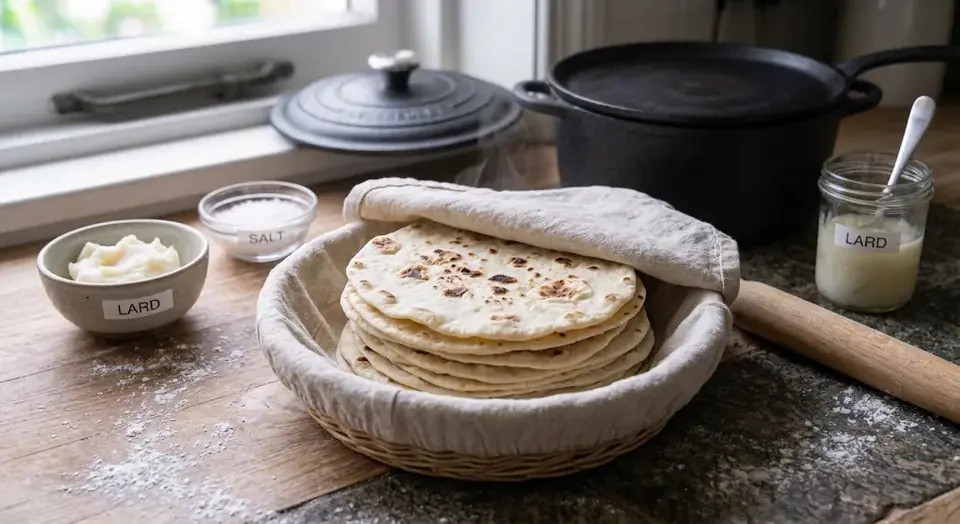
Soft northern-Mexican wheat rounds, blistered on a dry comal.
At a glance.
Flour Tortilla comes from Mexico · Sonora and the North and appears in The Bread Atlas, in the chapter Flatbreads. It makes 8 tortillas, is made on the griddle, and uses 5 ingredients and 11 steps.
- Yield
- Makes 8 tortillas
- Method
- Griddle, 1¼ hours
Ingredients
Tap an ingredient to tick it off.
- The Dough
Method
-
Whisk the flour, salt and baking powder together in a wide bowl. Add the soft lard and rub it through with your fingertips until the flour looks like damp sand and no lumps of fat remain larger than a grain of rice.
-
Pour in the water at 45°C and bring the dough together with a hand. Warm water melts the fat into the flour rather than seizing it, and it relaxes the gluten from the start, which is why every cook in Sonora heats the kettle first.
-
Knead 5 minutes on an unfloured surface until smooth, soft and slightly springy. This dough wants moderate development — enough to roll thin without tearing, not so much that it fights back. It should feel like a warm earlobe.
-
Divide into 8 pieces of about 105 g and roll each into a tight ball, the testales. Set them apart on a tray, coat the tops with a film of lard or oil, and cover with a cloth.
-
Rest 30 minutes at room temperature. This is not proving — there is no yeast in the bowl — it is gluten relaxation, and it is the single step that decides whether the dough rolls out or springs back at you.
-
Heat a comal, a heavy steel pan or a cast-iron skillet over medium-high until a drop of water dances and skids across it, about 200°C. Use no fat; the tortilla carries all it needs.
-
Roll one ball at a time on a barely floured surface to a round of 20–22 cm, turning it a quarter turn between passes and flipping it once. Aim for 1.5 mm — thin enough that the surface looks faintly translucent.
-
Lay the round on the hot surface. In 20–30 seconds the underside sets and small pale blisters rise. Turn it with fingers or a spatula before it takes deep color.
-
Give the second side 30–45 seconds. It should balloon somewhere across the middle, then subside. Brown freckles are wanted; a uniformly tanned tortilla has been cooked too long and will crack when folded.
-
Turn it back for a final 10 seconds if it has not puffed, pressing lightly with a folded cloth to push the steam sideways under the top skin.
-
Stack the tortillas as they come off inside a cloth-lined basket, folding the cloth over each one. They steam one another soft in the stack — a tortilla straight off the comal is stiffer than it will be in five minutes.
Cook’s notes
- To serve and keep
- In the north these wrap machaca and eggs at breakfast, carne asada with salsa and grilled onion at night, and beans and cheese in between. Serve them from the cloth so they stay warm through the meal. Store cooled and bagged; never leave a stack open to the air, where they dry within the hour.

Where it comes from
Wheat is not native to Mexico and neither is this bread. The Spanish brought it in the sixteenth century, and it took hold most firmly in the arid north — Sonora, Chihuahua, Coahuila, Nuevo León — where the land favored grain and cattle over maize and where the Jesuit missions of the Pimería Alta, established from 1687 under Eusebio Francisco Kino, planted wheat as a matter of policy. Cattle supplied the other half of the recipe: lard, which does for a tortilla what butter does for pastry. The northern form reaches its extreme in the Sonoran tortilla sobaquera, stretched by hand until it is nearly a meter across and thin enough to read through, draped over the forearm — the name comes from sobaco, armpit — and folded around machaca or carne asada. It is worth saying plainly that the flour tortilla is a regional bread, not a national one. Through central and southern Mexico maize is the tortilla, and offering a wheat one alongside a mole would be read as a small provincial mistake.
Flour Tortilla: quick answers
How many does this Flour Tortilla recipe make?
This recipe makes 8 tortillas.
Where does Flour Tortilla come from?
Wheat is not native to Mexico and neither is this bread. The Spanish brought it in the sixteenth century, and it took hold most firmly in the arid north — Sonora, Chihuahua, Coahuila, Nuevo León — where the land favored grain and cattle over maize and where the Jesuit missions of the Pimería Alta, established from 1687 under Eusebio Francisco Kino, planted wheat as a matter of policy. Cattle supplied the other half of the recipe: lard, which does for a tortilla what butter does for pastry. The northern form reaches its extreme in the Sonoran tortilla sobaquera, stretched by hand until it is nearly a meter across and thin enough to read through, draped over the forearm — the name comes from sobaco, armpit — and folded around machaca or carne asada. It is worth saying plainly that the flour tortilla is a regional bread, not a national one. Through central and southern Mexico maize is the tortilla, and offering a wheat one alongside a mole would be read as a small provincial mistake.
More from Mexico
 ChorizoMexico · Fresh Chile Sausage
 Breakfast BurritoNew Mexico · Southwestern Border Cooking
 Chia PuddingMesoamerica · Vanilla Base
 Tropical Fruit BowlMexico & Southeast Asia · Street Fruit
 Chia Berry BowlMexico · Chia, Hibiscus and the Modern Bowl
 Chocolate SmoothieMesoamerica & the American Soda Fountain
More in Flatbreads

https://www.atlasserie.com/recipes/bread/flour-tortilla/