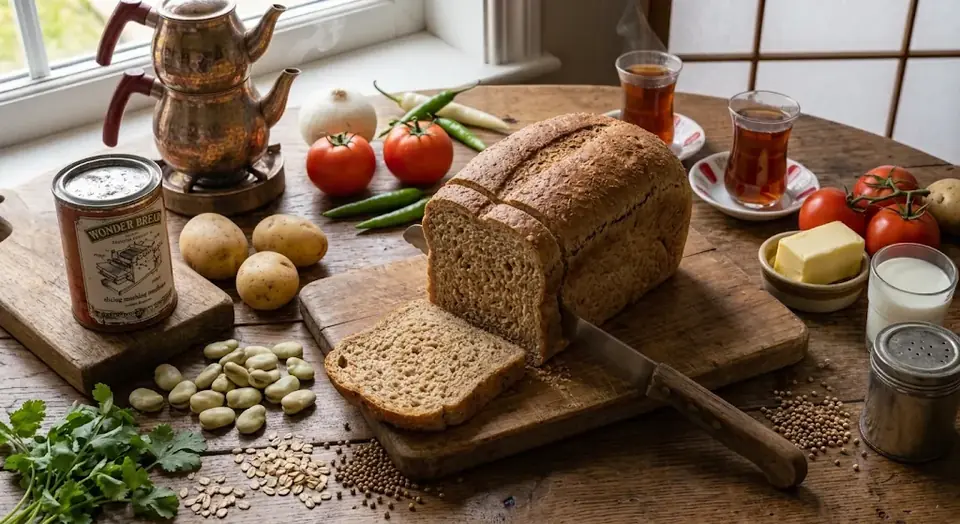
United States · The Wholemeal Revival · 39.87° N, 98.73° W
Whole Wheat Bread
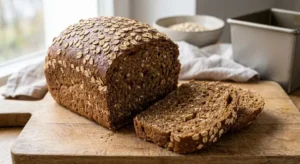
A full whole wheat tin loaf, nutty and moist rather than heavy.
At a glance.
Whole Wheat Bread comes from United States · The Wholemeal Revival and appears in The Bread Atlas, in the chapter Everyday Loaves & Sandwich Breads. It makes 1 loaf, is made by oven 200°c / 400°f, and uses 6 ingredients and 11 steps.
- Yield
- Makes 1 loaf
- Method
- Oven 200°C / 400°F, 4½ hours with the autolyse
Ingredients
Tap an ingredient to tick it off.
- The Dough
Method
-
Mix the flour with the water at 30°C to a shaggy mass, with nothing else in it, and cover. Leave 45 minutes. This is the autolyse, and on whole wheat it does more work than on any other dough in this chapter.
-
The dough will have gone from gritty to supple without a stroke of kneading. Sprinkle over the salt, yeast and honey, add the oil, and squeeze everything through until evenly combined and the dough looks briefly wrecked.
-
Knead 6 minutes only, by hand on an unfloured surface. Whole wheat cannot take the punishment a white dough can — bran fragments cut gluten strands as they are stretched, and long mixing shreds more than it builds. Target 26°C.
-
Bulk ferment 90 minutes at 26°C, giving one set of stretches and folds in the bowl at 30 and again at 60 minutes. The dough will firm noticeably between folds as the bran hydrates and the gluten organizes.
-
It is ready when risen by three-quarters, domed, and holding a slow-filling dent. Whole wheat gives less visual rise than white and ferments faster, so watch the clock and the feel rather than waiting for a doubling that may never come.
-
Turn out onto a lightly floured surface, press flat into a rectangle, and let it rest 10 minutes uncovered. Rested dough shapes tight; unrested whole wheat fights back and tears along the surface.
-
Roll into a firm cylinder the length of a greased 900 g tin, sealing the seam with the heel of your hand as you go. Drop it in seam-side down and press the corners so the dough meets the ends of the tin.
-
Prove 50–65 minutes at 26°C, until the crown stands 2 cm above the rim. Whole wheat over-proves quickly and has less gluten strength to hold the gas, so err early. Heat the oven to 200°C / 400°F with a steam tray on the floor.
-
Slash once down the length, 1 cm deep, load, and pour a cup of boiling water into the steam tray. Bake 20 minutes with steam, then vent the oven and bake 20–25 minutes more, until deep brown.
-
The loaf is done when it sounds hollow tapped on the base and reads 96°C in the center. Whole wheat needs the higher end of the range; taken out at 92°C the crumb sets sticky around the bran.
-
Turn out immediately onto a rack and leave 3 hours. This loaf keeps redistributing moisture as it cools, and cut at one hour it will seem damp and claggy when in fact it is only unfinished.
Cook’s notes
- To serve and keep
- Cut thick for cheese, ham and pickle, or toasted under a fried egg. It carries strong flavors that overwhelm white bread. Keep it in a cloth or paper rather than plastic, which softens the crust and encourages mold on a moist crumb.

Where it comes from
Whole wheat bread is less an old bread than a recovered one. Before the roller mills of the 1870s — Hungarian in design, built at industrial scale in Minneapolis — flour was stone-ground and carried some proportion of germ and bran, and sifting it out was laborious enough that white bread signified money. Rollers made the separation cheap and near-total. White flour also stopped going rancid, because the oil-rich germ had been removed, so it kept and shipped, and it became the standard within a generation. The reaction was quick and moral in tone. Sylvester Graham had already been lecturing American audiences in the 1830s against bolted flour, and in Britain the wartime National Loaf of 1942 put a high-extraction wheatmeal on every table by regulation, to general complaint. The 100% loaf as home bakers now make it belongs to the 1960s and 70s: co-operative mills, rediscovered stone grinding, and Edward Espe Brown's Tassajara Bread Book of 1970, which taught a generation to handle whole grain by feel.
Whole Wheat Bread: quick answers
How many does this Whole Wheat Bread recipe make?
This recipe makes 1 loaf.
Where does Whole Wheat Bread come from?
Whole wheat bread is less an old bread than a recovered one. Before the roller mills of the 1870s — Hungarian in design, built at industrial scale in Minneapolis — flour was stone-ground and carried some proportion of germ and bran, and sifting it out was laborious enough that white bread signified money. Rollers made the separation cheap and near-total. White flour also stopped going rancid, because the oil-rich germ had been removed, so it kept and shipped, and it became the standard within a generation. The reaction was quick and moral in tone. Sylvester Graham had already been lecturing American audiences in the 1830s against bolted flour, and in Britain the wartime National Loaf of 1942 put a high-extraction wheatmeal on every table by regulation, to general complaint. The 100% loaf as home bakers now make it belongs to the 1960s and 70s: co-operative mills, rediscovered stone grinding, and Edward Espe Brown's Tassajara Bread Book of 1970, which taught a generation to handle whole grain by feel.
More from United States






More in Everyday Loaves & Sandwich Breads
https://www.atlasserie.com/recipes/bread/whole-wheat-bread/