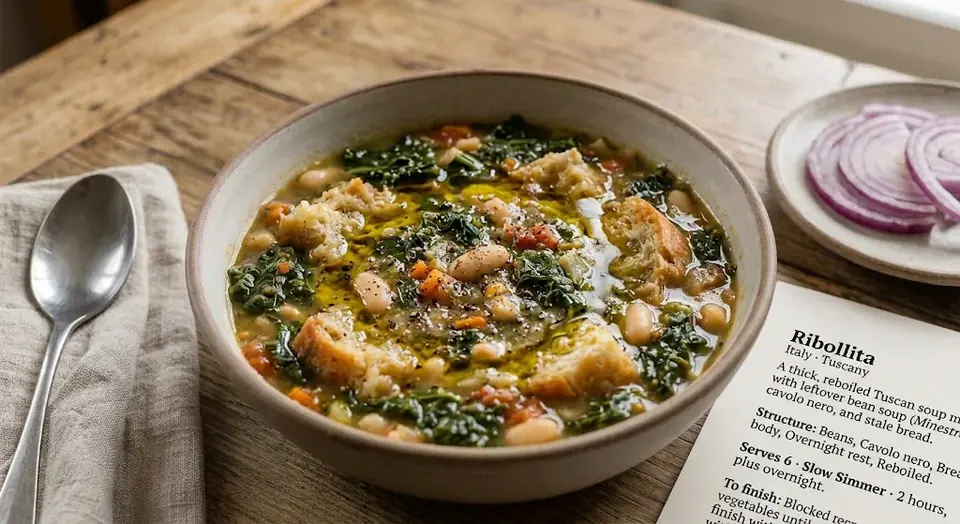
Italy · Tuscany · 43.43° N, 12.37° E
Ribollita
Yesterday's bean and cavolo nero soup, bread stirred in and boiled a second time.
At a glance.
Ribollita comes from Italy · Tuscany and appears in The Soup Atlas, in the chapter Beans, Lentils & Grains. It serves 6, takes about 2 hours, and uses 21 ingredients and 10 steps.
- Yield
- Serves 6
- Method
- Slow simmer
- Time
- 2 hours
Ingredients
Tap an ingredient to tick it off.
- For the beans
- For the day-one minestra
- For the bread
- For the reboil and the table
Method
-
Day one. Drain the soaked beans, cover them with the fresh water along with the garlic clove and sage, and simmer very gently for 60–75 minutes until tender to the center. Leave them in their liquid. Canned beans need no cooking, but keep their liquid too.
-
Warm the 60 ml of oil in a large heavy pot and add the onion, carrot and celery. Cook over low heat for a full 15 minutes, stirring occasionally. This is a longer sweat than most soups ask for, and the sweetness it builds is what carries a soup with no meat in it.
-
Add the sliced garlic and rosemary, cook 1 minute, then add the crushed tomatoes. Raise the heat slightly and cook for 10 minutes, until the tomato darkens from red to rust and the oil begins to separate out at the edge of the pan.
-
Add two-thirds of the beans, the stock, the bean liquid and the Parmesan rind. Simmer for 25 minutes. Blend the remaining third of the beans with a ladle of hot broth — jug a third full, lid vented, towel over the top — and stir the purée back in.
-
Add the cavolo nero and cabbage. They will look like far too much and will halve in volume within a minute. Cook for 20–25 minutes, until the black kale is completely soft and has given up its slightly bitter edge. This is the one green in the book you cook to death on purpose.
-
Season with the salt and taste hard. Take out the rind. Now tear in the stale bread, stir, and let it sit over low heat for 10 minutes, stirring occasionally, until the pieces have swollen, lost their edges and started to melt into the soup.
-
The pot is now minestra di pane, and it is a very good dinner in its own right. To make ribollita, cool it fast: divide it between two or three shallow containers so it drops below 5°C within two hours, then refrigerate uncovered until cold and cover overnight.
-
Day two. The soup will have set to a solid, sliceable mass; this is correct. Scrape it into a wide heavy pan or an earthenware pot with the 45 ml of olive oil and set it over medium-low heat with a splash of water.
-
Reboil it, breaking the mass down with a wooden spoon and stirring every few minutes, for 20–25 minutes. It should bubble thickly and sigh rather than simmer. Let a crust form on the base and stir it back in twice — this is where the second cooking earns its name.
-
Serve in warm shallow bowls, thick enough to eat with a fork. Top with the raw sliced red onion if you like the Tuscan habit, grind over black pepper, and pour on considerably more olive oil than feels reasonable. It is the seasoning, not the garnish.
Cook’s notes
- The technique
- The overnight rest does chemistry, not magic. Bread starch that gelatinized in the hot pot recrystallizes as it chills, squeezing out water and firming the whole mass, so the second cooking hydrates it again from a completely different starting point and the bread disappears into the soup rather than floating in it. Meanwhile the beans, kale and oil sit together long enough for fat-soluble aromatics to migrate through the whole pot. The frost matters too: cold nights make cavolo nero convert stored starch to sugar as antifreeze, which is why winter leaves taste sweeter.
- Make ahead
- The dish is make-ahead by definition — day one is not optional. Once reboiled it keeps another three days and can be reboiled again, which Tuscans do without embarrassment. It freezes acceptably for two months, though the bread turns slightly grainy. Cool it in shallow containers rather than leaving a deep pot on the counter.
- Troubleshooting
- Soupy rather than dense — not enough bread, or the loaf was too fresh and dissolved to slurry; add more torn stale bread on the reboil. Bitter — the cavolo nero was undercooked, so give it another fifteen minutes. Sour or fizzy — it was cooled too slowly in a deep pot and should be thrown out. Catching badly — add water and lower the heat, then let a light crust form deliberately.
- Variations
- Ribollita rifatta in padella takes cold slices of the set soup and fries them in oil until crusted on both sides, served with raw onion. Some households add a little chard or borage in place of cabbage. Zolfino or Sorana beans, if you can get them, make a notably finer version. Without the Parmesan rind, a soaked dried porcini and its strained liquid supply the missing savor.
- To serve and keep
- Wide, shallow bowls or an earthenware dish set in the middle of the table, eaten warm rather than scalding. Raw red onion, black pepper and a river of new-pressed oil. Drink a Chianti Classico, young and cool, or the local red the household happens to have. Made in full within this recipe — Minestra di Pane, Cooked Cannellini Beans, Blended Bean Purée. Also listed in the Component Index at the back.

Where it comes from
Ribollita means reboiled, and the word is a set of instructions rather than a description. Under the mezzadria sharecropping system that shaped Tuscan farming into the twentieth century, a household ate what it grew and wasted nothing, least of all bread, which was baked without salt in large loaves meant to last the week. Friday's minestra di pane — the bean and vegetable soup with bread stirred through it — became Saturday's ribollita by being cooked again. That is the whole idea, and the name of the day-one dish is different from the name of the day-two dish for a reason. Cavolo nero, the black kale of the Tuscan winter garden, is the other fixed element; growers and cooks agree that it is better after the first hard frost, and they are right for a measurable reason. The dish is a cousin of pappa al pomodoro, the tomato and bread soup at recipe 11, but the two are not interchangeable: one is bread with tomato, this is bread with beans and greens. Both belong to the same argument about what to do with a stale loaf.
Ribollita: quick answers
How long does Ribollita take?
About 2 hours.
How many does this Ribollita recipe make?
This recipe serves 6.
Where does Ribollita come from?
Ribollita means reboiled, and the word is a set of instructions rather than a description. Under the mezzadria sharecropping system that shaped Tuscan farming into the twentieth century, a household ate what it grew and wasted nothing, least of all bread, which was baked without salt in large loaves meant to last the week. Friday's minestra di pane — the bean and vegetable soup with bread stirred through it — became Saturday's ribollita by being cooked again. That is the whole idea, and the name of the day-one dish is different from the name of the day-two dish for a reason. Cavolo nero, the black kale of the Tuscan winter garden, is the other fixed element; growers and cooks agree that it is better after the first hard frost, and they are right for a measurable reason. The dish is a cousin of pappa al pomodoro, the tomato and bread soup at recipe 11, but the two are not interchangeable: one is bread with tomato, this is bread with beans and greens. Both belong to the same argument about what to do with a stale loaf.
More from Italy





More in Beans, Lentils & Grains
https://www.atlasserie.com/recipes/soup/ribollita/