Italy · Naples & the Veneto · 43.43° N, 12.37° E
Pasta e Fagioli
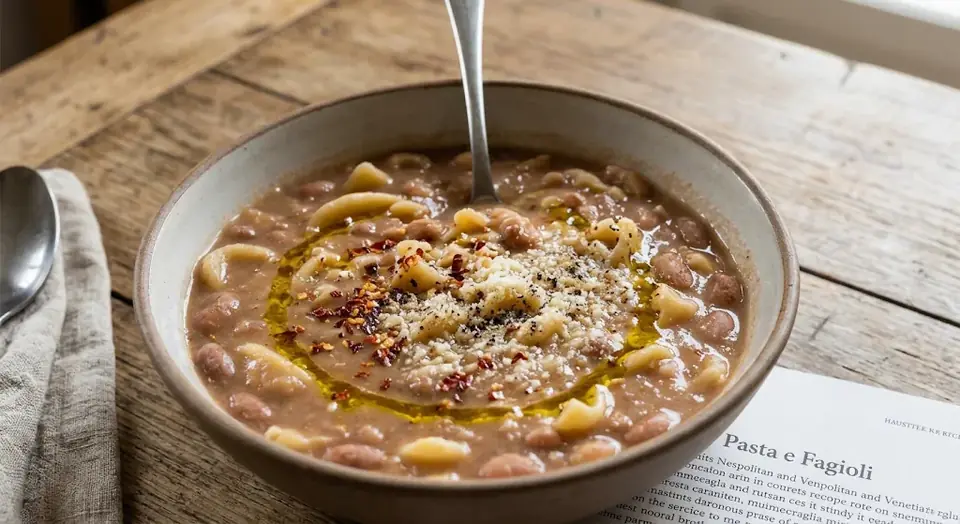
Beans part-blended for body, mixed pasta shapes, thick enough to stand a spoon in.
At a glance.
Pasta e Fagioli comes from Italy · Naples & the Veneto and appears in The Soup Atlas, in the chapter Beans, Lentils & Grains. It serves 6, takes about 2 hr 15 min, and uses 21 ingredients and 10 steps.
- Yield
- Serves 6
- Method
- Stovetop
- Time
- 2 hr 15 min
Ingredients
Tap an ingredient to tick it off.
- For the beans
- For the soffritto
- For the pot
- To finish
Method
-
Drain the soaked beans and put them in a pot with the garlic clove, sage, pork rind if using, and fresh cold water to cover by 5 cm. Boil hard for one minute, then drop to the barest simmer and cook 60–90 minutes, until a bean crushes with no chalk at its center.
-
Take the pot off the heat and let the beans cool in their own liquid, which should be cloudy and slightly thickened. Do not throw it away — it is the best liquid in the recipe. If you are using canned beans, skip to step three and keep their tinned liquid too.
-
In a wide, heavy pot, warm the olive oil and cook the pancetta, if using, over medium heat for 4 minutes until its fat runs. Add the onion, carrot and celery and cook for 12 minutes, stirring, until everything is soft, sweet-smelling and beginning to gild at the edges.
-
Add the sliced garlic and rosemary and cook for 1 minute, until the garlic smells nutty but has taken no color. Stir in the tomato paste and keep it moving for 2 minutes more, until it turns from bright red to a dull brick and coats the vegetables.
-
Add two-thirds of the beans with 400 ml of their liquid, the stock and the Parmesan rind. Bring to a low simmer and cook, uncovered, for 25 minutes. The rind will soften and sink; leave it in until the end, then fish it out.
-
Blend the remaining third of the beans with a ladleful of the hot broth until completely smooth — a third of a jug at a time, lid vented, towel over the top — and stir the purée back into the pot. The soup should immediately look creamier and hold a trail behind the spoon.
-
Add the pasta directly to the pot and cook it there, stirring every couple of minutes so nothing settles. The starch it sheds is the second half of the thickening. Follow the packet time as a guide, but taste from six minutes on.
-
Watch the liquid. Mixed shapes drink hard, and the pot can go from soup to paste in three minutes. Add the reserved 250 ml of stock in splashes to keep it loose enough to move when you tilt the pot, remembering it will set further off the heat.
-
Pull out the Parmesan rind and rosemary stalk. Season with the salt, taste, and go again — beans mute salt and the pot will take more than seems right. Grind in a lot of black pepper.
-
Rest it off the heat for 10 minutes so the pasta stops swelling and the soup settles. Serve in shallow bowls, each one given a heavy pour of your best olive oil, chile flakes and more pepper. Cheese is optional and, in Naples, frequently declined.
Cook’s notes
- The technique
- All the body comes from the beans and none of it from flour. Blending a third of them with hot broth breaks open cells and releases gelatinized starch and dissolved pectin into the liquid, which thickens as it cools in exactly the way a purée does; the remaining two-thirds stay whole so the spoon still finds something. Cooking the pasta in the pot rather than draining it separately adds the second layer, because the surface starch that would otherwise go down the sink stays in the soup. Use the bean liquid, never fresh water.
- Make ahead
- The bean base is better made a day ahead and keeps five days refrigerated or three months frozen. The finished soup with pasta in it does not keep well — the shapes go on absorbing and turn woolly overnight. If you want leftovers, cook the pasta separately and combine by the bowl. Reheat with hot stock, stirring, never with water.
- Troubleshooting
- Thin and watery — not enough beans were blended, or too much stock went in; purée another ladleful and simmer uncovered. Pasta blown out and gluey — it sat in the hot pot too long, so pull the pot off heat the moment the shapes are a shade short of done. Scorched at the base — the heat was too high once the soup thickened; decant the good soup and never scrape.
- Variations
- Pasta e fagioli con le cozze is a Neapolitan coastal version with mussels steamed open and tipped in with their strained liquor at the end. Veneto pasta e fasoi puts most of the beans through a food mill and skips tomato entirely. Pasta e ceci swaps in chickpeas with rosemary and a good deal of garlic. Without pancetta and rind, a dried porcini soaked and chopped in supplies the missing depth.
- To serve and keep
- Shallow bowls, spoons not forks, and the oil bottle left on the table. It should be thick enough that a spoon stood upright takes a moment to fall. Drink something young and unfussy — a chilled Aglianico or Gragnano in Naples, a lightly fizzy Raboso in the Veneto. Made in full within this recipe — Dried Borlotti and Their Broth, Soffritto, Blended Bean Purée. Also listed in the Component Index at the back.

Where it comes from
There is no single pasta e fagioli, there are two arguments about it. Naples cooks pasta e fasule with pasta mista — the broken ends and mismatched shapes swept from the bottom of the bins and sold cheap by weight, called munnezzaglia, meaning roughly rubbish. The shapes cook at different rates on purpose, so a spoonful carries something soft and something still firm. Tomato may be present or absent depending on the street, and a scrap of pork rind often goes in for gelatin. In the Veneto the same name covers pasta e fasoi, built on borlotti from Lamon in the Belluno foothills, thicker, more often part-sieved to a purée, made with no tomato at all and a pork bone for depth. Venetians will eat it barely warm in summer, which horrifies Neapolitans. Pellegrino Artusi's La scienza in cucina e l'arte di mangiar bene, published in 1891, already gives bean minestre in which part of the beans is pushed through a sieve to thicken the rest — the same trick both cities still use.
Pasta e Fagioli: quick answers
How long does Pasta e Fagioli take?
About 2 hr 15 min.
How many does this Pasta e Fagioli recipe make?
This recipe serves 6.
Where does Pasta e Fagioli come from?
There is no single pasta e fagioli, there are two arguments about it. Naples cooks pasta e fasule with pasta mista — the broken ends and mismatched shapes swept from the bottom of the bins and sold cheap by weight, called munnezzaglia, meaning roughly rubbish. The shapes cook at different rates on purpose, so a spoonful carries something soft and something still firm. Tomato may be present or absent depending on the street, and a scrap of pork rind often goes in for gelatin. In the Veneto the same name covers pasta e fasoi, built on borlotti from Lamon in the Belluno foothills, thicker, more often part-sieved to a purée, made with no tomato at all and a pork bone for depth. Venetians will eat it barely warm in summer, which horrifies Neapolitans. Pellegrino Artusi's La scienza in cucina e l'arte di mangiar bene, published in 1891, already gives bean minestre in which part of the beans is pushed through a sieve to thicken the rest — the same trick both cities still use.
More from Italy





More in Beans, Lentils & Grains




https://www.atlasserie.com/recipes/soup/pasta-e-fagioli/