France · 46.56° N, 2.35° E
Quiche Lorraine
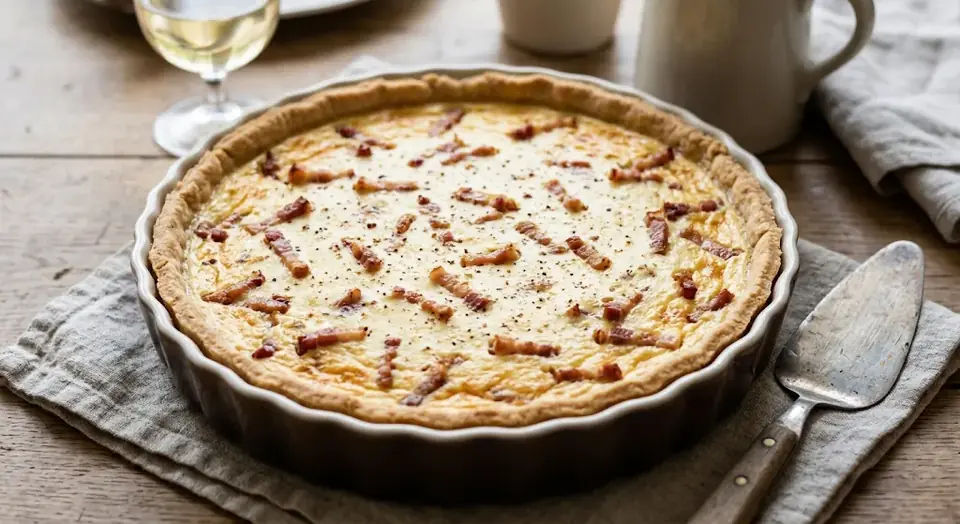
A deep, pale custard barely set around smoky lardons, with no cheese anywhere in it.
At a glance.
Quiche Lorraine comes from France and appears in The Pie Atlas, in the chapter Savory Pies & Pot Pies. It serves 8, bakes at 350°F (175°C) for 35 minutes, and uses 10 ingredients and 8 steps.
- Yield
- Serves 8
- Method
- Oven
- Oven
- 350°F / 175°C
- Bake
- 35 minutes
Ingredients
Tap an ingredient to tick it off.
Method
-
Roll the brisée to 1/8 inch (3 mm) and line the tin without stretching it, easing the dough down into the corner with a knuckle. Pastry pulled taut over a rim will contract in the heat and slump down the sides.
-
Chill the lined tin for 30 minutes, then blind-bake at 375°F (190°C) with parchment and weights for 20 minutes, and a further 10 to 12 minutes uncovered until the base is sandy and pale gold.
-
Brush the hot shell with egg white and return it to the oven for 2 minutes. The white sets into a thin waterproof film, the single most effective defense against a wet custard soaking the base.
-
Fry the lardons in a dry pan over medium heat for 8 minutes, until the fat has run and the edges are crisp. Drain them on paper, because that rendered fat will not emulsify into the custard and would pool on top.
-
Whisk the eggs, yolk, cream, and milk with the nutmeg, salt, and white pepper until uniform but not frothy. Beaten-in air rises during baking and leaves a spongy, souffléd top rather than a dense one.
-
Drop the oven to 350°F (175°C). Scatter the lardons across the shell, set the tin on a pulled-out rack, and pour in the custard to within 1/8 inch (3 mm) of the rim so nothing spills on the way in.
-
Bake 35 minutes. It is done when the outer 2 inches (5 cm) are set and the center still shivers as a single mass, reading 175°F (79°C); carryover heat finishes it on the counter.
-
Cool at least 30 minutes before unmolding. Quiche is at its best warm rather than hot, and it holds 3 days refrigerated.
Cook’s notes
- Good to know
- Egg proteins begin to coagulate near 145°F (63°C) but tighten and squeeze out water above about 180°F (82°C), which is why an overbaked quiche puffs, cracks, and then weeps a puddle as it cools. Fat from the cream physically gets between those proteins and slows the process, which is why cream custards forgive more than milk custards do.

Where it comes from
The name is Germanic, not French: quiche comes from the Alemannic Küchen, cake, and Lorraine — Lothringen — spent centuries as German-speaking territory on a contested border. The original was as plain as it sounds, an open case filled with eggs, cream, and bacon, and cheese was no part of it; a version with cheese is properly a different dish, and one with onion belongs to Alsace. The ratio is the only thing worth memorizing here: one large egg to every 1/2 cup (120 ml) of dairy gives a custard that sets softly and slices clean.
Quiche Lorraine: quick answers
How long does Quiche Lorraine take to bake?
Quiche Lorraine bakes at 350°F (175°C) for 35 minutes. Use the visual cues in the method as well as the clock.
How many does this Quiche Lorraine recipe make?
This recipe serves 8.
Where does Quiche Lorraine come from?
The name is Germanic, not French: quiche comes from the Alemannic Küchen, cake, and Lorraine — Lothringen — spent centuries as German-speaking territory on a contested border. The original was as plain as it sounds, an open case filled with eggs, cream, and bacon, and cheese was no part of it; a version with cheese is properly a different dish, and one with onion belongs to Alsace. The ratio is the only thing worth memorizing here: one large egg to every 1/2 cup (120 ml) of dairy gives a custard that sets softly and slices clean.
What is the secret to a good Quiche Lorraine?
Bake it on the middle shelf of a moderate oven and resist raising the temperature to save time, because a fast custard is a curdled custard.
The same dish in another volume
More from France




More in Savory Pies & Pot Pies

https://www.atlasserie.com/recipes/pie/quiche-lorraine-pie/