
North America · The Porridge Loaf · 39.87° N, 98.73° W
Multigrain Bread
Cracked grains cooked to porridge first, for a moist dark crumb.
At a glance.
Multigrain Bread comes from North America · The Porridge Loaf and appears in The Bread Atlas, in the chapter Everyday Loaves & Sandwich Breads. It makes 1 loaf, takes about 5 hours, and uses 12 ingredients and 11 steps.
- Yield
- Makes 1 loaf
- Method
- Oven 200°C / 400°F
- Time
- 5 hours
Ingredients
Tap an ingredient to tick it off.
- Cracked-Grain Porridge (Scald)
- The Dough
Method
-
Bring the cracked grains, salt and water to a boil in a small heavy pan, then turn the heat right down, cover, and cook 20–25 minutes, stirring twice, until the grains are tender and the mixture is a thick porridge that holds the mark of a spoon.
-
Spread the porridge on a tray to cool to 26°C, which takes about an hour. Weigh what you have: it should be close to 380 g. If it has reduced further, stir in enough water to bring it back, or the dough will be short of liquid.
-
This is what separates a porridge from a soaker. A cold soak swells the grain and softens it; boiling bursts the starch granules entirely, releasing free starch that binds several times its own weight of water and stays bound through the bake.
-
Mix both flours with the water at 28°C and rest 30 minutes. Add the porridge, oil, salt and yeast, and squeeze everything through the fingers until no streaks of pale dough or lumps of porridge remain.
-
Knead 6 minutes only. The dough will be soft, heavy and a little sticky, and it will not develop the clean elasticity of a plain wheat dough because the porridge is diluting the gluten. Mix to finish at 26°C.
-
Bulk ferment 90 minutes at 26°C with folds at 30 and 60 minutes. The dough strengthens visibly between folds. It is ready when risen by two-thirds, domed, and holding its shape when the bowl is tilted.
-
Turn out onto a floured bench, press flat, and roll into a tight cylinder for a greased 900 g tin, pressing the seam closed firmly. This is a heavy dough and it needs the support of the tin; free-form, it would spread.
-
Prove 55–65 minutes at 26°C until the crown clears the rim by 2 cm and a dent fills back halfway. Bring the oven to 200°C / 400°F, with a heavy tray heating on the floor for steam.
-
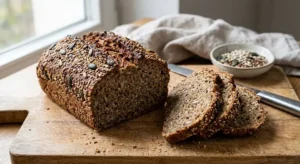
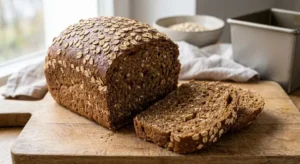
Brush with water, scatter a few cracked grains over the top, and slash once down the length. Load, add a cup of boiling water to the tray, and bake 20 minutes with steam.
-
Vent the oven and bake 30–35 minutes more, to a dark chestnut crust and an internal 97°C. Total liquid here runs above 100% of the flour weight, and a loaf this wet needs a long, committed bake to set its crumb.
-
Cool at least 4 hours, and overnight if you can manage it. The crumb continues to firm and the flavor of the cooked grain — sweet, faintly malty — comes forward well after the loaf has gone cold.
Cook’s notes
- To serve and keep
- Cut thick for cheese and chutney, or toast it and eat it with butter and honey. It is the best of these loaves under a soft-boiled egg. Store wrapped in a cloth; the crust stays chewy rather than crisp, which suits it.

Where it comes from
Multigrain is a marketing word before it is a baking one. Nothing in it guarantees whole grain, and a loaf can carry five named grains in quantities too small to taste while remaining, in substance, white bread with decoration. The honest version of the idea is much older and comes from the porridge pot: cooked grain, often yesterday's leftovers, stirred into a dough because it was there and because it made the bread better. Scottish and Scandinavian kitchens did this with oats, barley and rye as a matter of course, and the practice was never written up because it was too ordinary to record. It returned to professional baking with real force in the 2000s, when American and Scandinavian bakers began cooking grains deliberately rather than using up scraps — Chad Robertson's Tartine Book No. 3, published in 2013, made porridge breads a named category. The difference from a cold soaker is not a detail. Cooking gelatinizes the starch, and gelatinized starch behaves like a different ingredient.
Multigrain Bread: quick answers
How long does Multigrain Bread take?
About 5 hours.
How many does this Multigrain Bread recipe make?
This recipe makes 1 loaf.
Where does Multigrain Bread come from?
Multigrain is a marketing word before it is a baking one. Nothing in it guarantees whole grain, and a loaf can carry five named grains in quantities too small to taste while remaining, in substance, white bread with decoration. The honest version of the idea is much older and comes from the porridge pot: cooked grain, often yesterday's leftovers, stirred into a dough because it was there and because it made the bread better. Scottish and Scandinavian kitchens did this with oats, barley and rye as a matter of course, and the practice was never written up because it was too ordinary to record. It returned to professional baking with real force in the 2000s, when American and Scandinavian bakers began cooking grains deliberately rather than using up scraps — Chad Robertson's Tartine Book No. 3, published in 2013, made porridge breads a named category. The difference from a cold soaker is not a detail. Cooking gelatinizes the starch, and gelatinized starch behaves like a different ingredient.
More from United States






More in Everyday Loaves & Sandwich Breads
https://www.atlasserie.com/recipes/bread/multigrain-bread/