The Soup Atlas
Chicken and Rice Soup
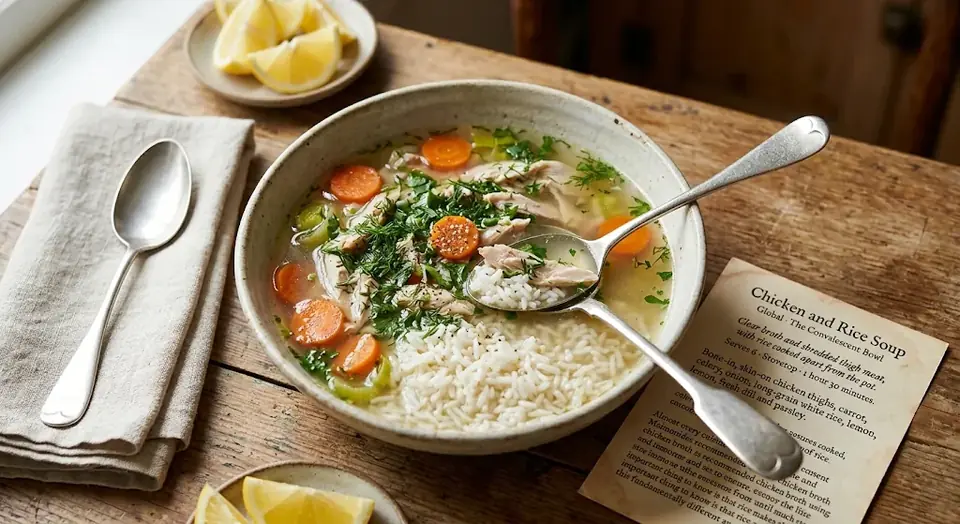
Clear broth and shredded thigh meat, with rice cooked apart from the pot.
At a glance.
Chicken and Rice Soup is a recipe from The Soup Atlas, in the chapter Beans, Lentils & Grains. It serves 6, takes about 1 hr 30 min, and uses 22 ingredients and 10 steps.
- Yield
- Serves 6
- Method
- Stovetop
- Time
- 1 hr 30 min
Ingredients
Tap an ingredient to tick it off.
- For the broth
- For the rice, cooked separately
- For the finished soup
Method
-
Put the chicken thighs in a pot with the cold water, halved onion, carrot and celery, the crushed garlic, bay, thyme, parsley stalks, peppercorns and salt. Starting cold matters: proteins that would set into scum at a boil instead rise slowly and can be skimmed.
-
Bring it to the edge of a simmer over medium-low heat, skimming the gray foam as it collects. From then on hold it so that a bubble breaks the surface once every second or two. A rolling boil emulsifies fat into the liquid and turns the broth cloudy for good.
-
Poach for 45 minutes. The chicken is done when the meat pulls easily from the bone and the juices run clear; if you want a number, the thickest part of the thigh should read 74°C (165°F). Lift the pieces out onto a plate and let them cool enough to handle.
-
Strain the broth through a fine sieve into a clean pot and discard the spent aromatics — they have given everything they have. If you want it clearer still, let it settle for ten minutes and spoon the fat off the surface, or chill it and lift the set cap.
-
Pull the meat off the bones in large shreds, discarding skin, bone and cartilage. Cover it so it does not dry out. There should be around 500 g of meat.
-
Cook the rice separately, and read the technique note before you decide otherwise. Combine the rinsed rice, water, salt and butter in a small pan, bring to a boil, cover, drop to the lowest heat for 12 minutes, then leave it covered off the heat for 10 more. Fork it loose.
-
Melt the 20 g of butter in the pot of strained broth and add the sliced carrot, celery and leek. Simmer for 8–10 minutes, until the carrot is tender but still has a little resistance at the center. Vegetables cooked in clear broth go soft faster than you expect.
-
Return the shredded chicken and warm it through for 3 minutes only. It is already cooked, and a long second simmer dries the fibers and makes them stringy. Taste the broth now and season firmly with salt and white pepper.
-
Take the pot off the heat and add the lemon juice. Taste again. The broth should read bright and savory rather than sour; the acid is there to sharpen the salt and cut the fat, not to be noticed on its own.
-
Spoon a mound of hot rice into each warm bowl and ladle the soup over it. Scatter dill and parsley across the top and put lemon wedges on the table. Assemble bowl by bowl, and keep the leftover rice and broth in separate containers.
Cook’s notes
- The technique
- Rice never stops drinking. Its starch granules go on absorbing water and swelling for as long as there is liquid and warmth available, well below simmering point, so a pot that is correct at the stove will be thick at the table and porridge by morning. It also retrogrades on chilling, turning the grains firm and chalky in a broth they have already drunk. Cooking the rice separately and combining by the bowl solves both problems permanently, and costs you one small saucepan. Cooked rice also needs care: cool it within an hour, refrigerate no more than a day, and reheat until steaming, because Bacillus cereus spores survive cooking and multiply at room temperature.
- Make ahead
- Broth and meat keep four days refrigerated and three months frozen, and both improve slightly overnight as the gelatin sets and the flavor rounds. Store the rice in its own covered container for no more than a day. Reheat the broth to a full simmer, add the rice cold to the bowl and ladle over it. Add lemon and herbs fresh every time.
- Troubleshooting
- Cloudy and greasy — the pot boiled; strain it, chill it and lift off the fat. Broth thin and characterless — too much water for the amount of bone, so reduce it hard and season again. Chicken dry and stringy — it was simmered a second time; return it for minutes, not half-hours. Soup turned to porridge overnight — the rice went into the pot, which it should not have.
- Variations
- Greek kotosoupa avgolemono is finished by whisking two eggs with lemon juice, tempering with hot broth a ladle at a time, then stirring the mixture in off the heat so it thickens without scrambling. Puerto Rican asopao adds sofrito, olives and capers and cooks the rice in the pot deliberately, to be eaten at once. Mexican caldo de pollo comes with lime, avocado and chile. Congee simmers rice into the broth for two hours until it is fully dissolved.
- To serve and keep
- Warm bowls, rice added first, broth poured over at the table so nothing sits and swells. Crusty bread and butter, lemon wedges, more dill for anyone who wants it. Drink nothing complicated — water, or weak tea if the bowl is going to somebody unwell. Made in full within this recipe — Clear Chicken Broth, Separately Cooked Rice. Also listed in the Component Index at the back.
Where it comes from
Almost every cuisine that has both chickens and rice has arrived at this bowl independently, and almost every one of them serves it to the sick. Greek kotosoupa is finished with avgolemono, egg and lemon whisked into the hot broth. Puerto Rican and Dominican asopao is thicker and closer to a wet rice than a soup. Mexican caldo de pollo comes with rice, lime and chile on the side. Chinese jook or congee cooks the grain until it disintegrates entirely. Sephardic, Persian and Levantine kitchens all have a version. The medicinal reputation is older than any of them — Maimonides recommended chicken broth for respiratory illness in the twelfth century — and modern work has been oddly supportive: a 1978 study in Chest measured hot chicken soup clearing nasal mucus faster than hot water, and a 2000 paper in the same journal found chicken soup mildly inhibited neutrophil migration in the laboratory. Neither proves a cure. Both suggest the folk wisdom was not baseless. The important thing to know is that rice makes this a fundamentally different dish from the noodle soups of Chapter One.
Chicken and Rice Soup: quick answers
How long does Chicken and Rice Soup take?
About 1 hr 30 min.
How many does this Chicken and Rice Soup recipe make?
This recipe serves 6.
Where does Chicken and Rice Soup come from?
Almost every cuisine that has both chickens and rice has arrived at this bowl independently, and almost every one of them serves it to the sick. Greek kotosoupa is finished with avgolemono, egg and lemon whisked into the hot broth. Puerto Rican and Dominican asopao is thicker and closer to a wet rice than a soup. Mexican caldo de pollo comes with rice, lime and chile on the side. Chinese jook or congee cooks the grain until it disintegrates entirely. Sephardic, Persian and Levantine kitchens all have a version. The medicinal reputation is older than any of them — Maimonides recommended chicken broth for respiratory illness in the twelfth century — and modern work has been oddly supportive: a 1978 study in Chest measured hot chicken soup clearing nasal mucus faster than hot water, and a 2000 paper in the same journal found chicken soup mildly inhibited neutrophil migration in the laboratory. Neither proves a cure. Both suggest the folk wisdom was not baseless. The important thing to know is that rice makes this a fundamentally different dish from the noodle soups of Chapter One.
More in Beans, Lentils & Grains

https://www.atlasserie.com/recipes/soup/chicken-and-rice-soup/