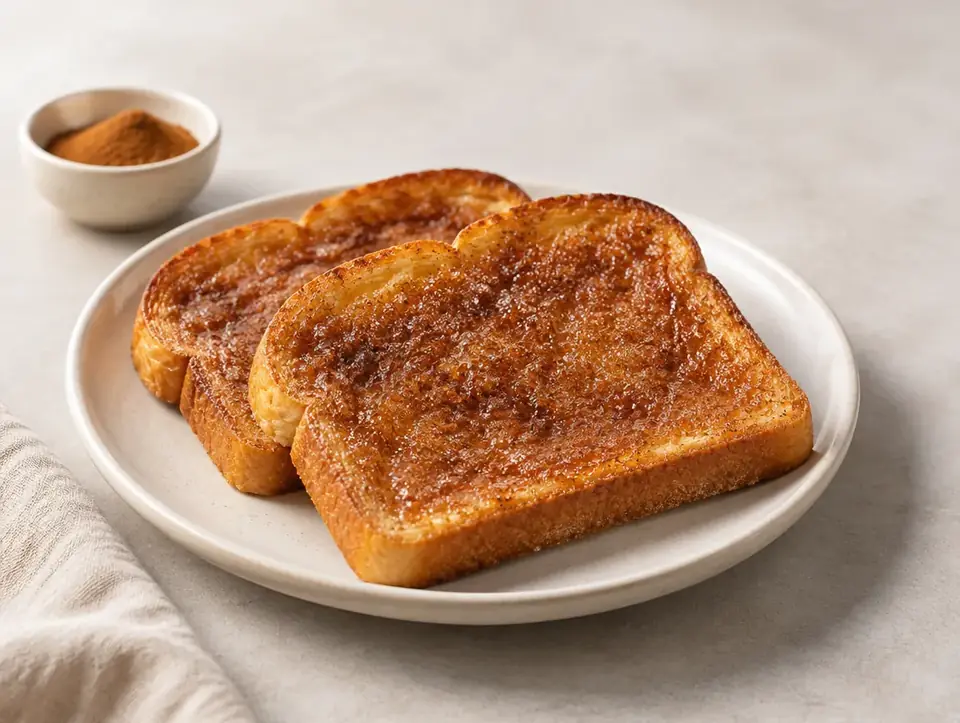
United States · Mid-Century Childhood · 39.87° N, 98.73° W
Cinnamon Toast
A broiled butter paste that sets into a crackling cinnamon glaze.
At a glance.
Cinnamon Toast comes from United States · Mid-Century Childhood and appears in The Breakfast Atlas, in the chapter Toast & Breakfast Breads. It serves 2, takes about 10 minutes, and uses 6 ingredients and 10 steps.
- Yield
- Serves 2
- Method
- Oven
- Time
- 10 minutes
Ingredients
Tap an ingredient to tick it off.
- For the cinnamon butter paste (enough for 4 slices)
Method
-
Set an oven rack about 12 cm (5 in) below the broiler element and heat the broiler on high for 5 minutes. A cold element browns in patches, scorching one corner while the rest stays grainy.
-
Beat the softened butter with a fork or small spatula until it turns pale and creamy. Cold, waxy butter will not take up the sugar, and you end up with sweet halves and unsweet halves.
-
Work in the sugar, cinnamon, salt and vanilla to a smooth, spreadable paste. The proportion to remember is four parts sugar to one part cinnamon by volume; push past that and the mixture turns dusty and faintly bitter.
-
Toast the bread lightly first, about sixty percent of the way to pale gold, in a toaster or under the broiler. Drying the surface means the melting butter sits on top instead of vanishing into the crumb.
-
Spread the paste right out to the crusts on one side, about a tablespoon per slice. Any bare margin will blacken under the broiler before the covered area has begun to caramelize.
-
Slide the slices onto a foil-lined tray and broil for 1–2 minutes. Stay at the open oven door; at this distance the journey from bubbling to burnt takes roughly fifteen seconds.
-
Watch for the surface to bubble across its whole area and darken at the edges to the color of maple syrup. That bubbling is water leaving the butter and the sugar beginning to caramelize.
-
Pull the tray the moment the bubbling slows. Let the toast sit on the tray for 2 minutes: the molten sugar sets into a thin brittle sheet as it cools, and that sheet is the entire point of the method.
-
Cut each slice into three fingers with a serrated knife, sawing rather than pressing, so the glaze cracks in clean lines instead of shattering off the bread.
-
Serve warm but not hot. Molten sugar holds heat far above the temperature of the bread beneath it and will burn a mouth that trusts it.
Cook’s notes
- The technique
- Creaming the butter with the sugar is what separates a glaze from a dusting. Dry cinnamon sugar scattered over butter never fully dissolves, so it stays granular and slides. Blended into softened butter it forms a suspension that melts evenly, and under the broiler the water boils off while the sucrose begins to caramelize around 160°C (320°F), setting on cooling into a lacquer that cracks under the teeth.
- Make ahead
- The paste keeps two weeks refrigerated and three months frozen. Roll it into a log in parchment and cut 15 g discs straight from cold — they soften on hot toast in under a minute. Let it come to room temperature before spreading on untoasted bread.
- Troubleshooting
- Sugar burnt while the bread stayed pale — the rack sat too close; drop it a level. Gritty, dry finish — the butter was too cold to absorb the sugar. Glaze that never sets — pulled before the surface bubbled all over, or eaten too soon after coming out.
- Variations
- Add ¼ teaspoon ground cardamom and a scrape of orange zest for a Scandinavian slant. Swap half the sugar for maple sugar for a deeper, less piercing sweetness. In Mexico a related habit sees bolillo halves buttered, dusted with canela and toasted on the comal.
- Serve with
- Cold milk is the historically correct partner and still the best one. Sliced banana or stewed apple on the side stops it being pure sugar. For adults, strong black coffee or a cup of Assam. Made in full within this recipe — Cinnamon Butter Paste. Also listed in the Component Index at the back.

Where it comes from
Cinnamon toast belongs to American childhood the way jam toast belongs to British. Recipes for it appear in American household cookbooks from the late nineteenth century onward, once cheap ground cassia and cheap refined sugar landed in the same grocery basket and turned a spice that had underwritten Portuguese and Dutch trading empires into an everyday sprinkle. It came into its own in the mid-twentieth century as after-school food and sickroom food, made under the broiler by mothers and, soon enough, by children old enough to be trusted with the grill. General Mills paid the dish the compliment of imitation in 1984 with a breakfast cereal built entirely around the flavor. Most of what is sold and remembered as cinnamon toast is a dry dusting of sugar scattered over butter, which slides off into the lap on the first bite. The version worth making creams butter, sugar and spice into a paste and melts it under direct heat, so the sugar caramelizes into a thin sheet that cracks.
Cinnamon Toast: quick answers
How long does Cinnamon Toast take?
About 10 minutes.
How many does this Cinnamon Toast recipe make?
This recipe serves 2.
Where does Cinnamon Toast come from?
Cinnamon toast belongs to American childhood the way jam toast belongs to British. Recipes for it appear in American household cookbooks from the late nineteenth century onward, once cheap ground cassia and cheap refined sugar landed in the same grocery basket and turned a spice that had underwritten Portuguese and Dutch trading empires into an everyday sprinkle. It came into its own in the mid-twentieth century as after-school food and sickroom food, made under the broiler by mothers and, soon enough, by children old enough to be trusted with the grill. General Mills paid the dish the compliment of imitation in 1984 with a breakfast cereal built entirely around the flavor. Most of what is sold and remembered as cinnamon toast is a dry dusting of sugar scattered over butter, which slides off into the lap on the first bite. The version worth making creams butter, sugar and spice into a paste and melts it under direct heat, so the sugar caramelizes into a thin sheet that cracks.
More from United States


More in Toast & Breakfast Breads
https://www.atlasserie.com/recipes/breakfast/cinnamon-toast/