Britain · Preserves & Marmalade · 53.77° N, 2.57° W
Jam Toast
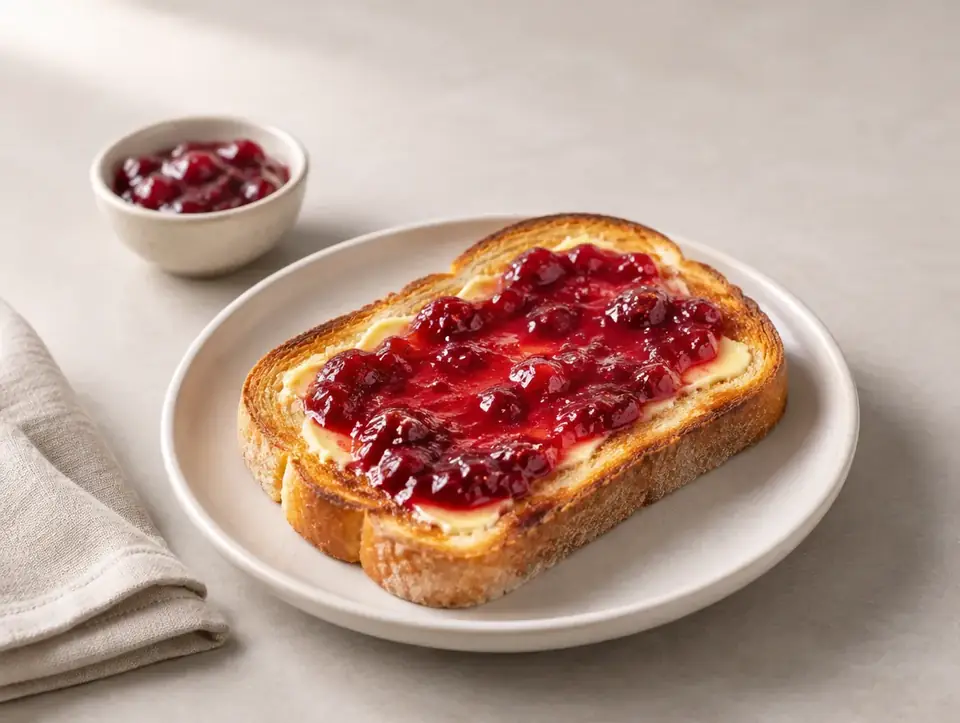
Buttered toast under a berry jam made while the bread browns.
At a glance.
Jam Toast comes from Britain · Preserves & Marmalade and appears in The Breakfast Atlas, in the chapter Toast & Breakfast Breads. It serves 2, takes about 30 minutes, and uses 7 ingredients and 10 steps.
- Yield
- Serves 2
- Method
- Stovetop
- Time
- 30 minutes
Ingredients
Tap an ingredient to tick it off.
- For the 15-minute refrigerator jam (makes about 250 g)
Method
-
Put a small plate in the freezer. It is the only reliable set test available without a thermometer, and you will want it in twelve minutes' time.
-
Tip the fruit, sugar, lemon juice, zest strips and salt into a wide saucepan. Width matters: evaporation is what thickens jam, and a narrow pan concentrates far too slowly to work in this timeframe.
-
Stir over low heat for 2–3 minutes until the sugar has completely dissolved. Rub a little of the liquid between finger and thumb; if you feel grit, keep going, because undissolved sugar crystallizes in the finished jar.
-
Raise the heat and boil hard for 8–10 minutes, stirring often and scraping the corners. The bubbles shift from loose and watery to small, glossy and slow, and the mixture starts to sound thicker against the spoon.
-
Test the set: drop a little onto the frozen plate, wait 30 seconds, then push it with a fingertip. It should wrinkle and hold an open channel. If it floods back, boil 2 minutes more and test again.
-
Stir in the optional butter to disperse the foam, fish out the zest strips, and pour into a clean jar. This is a refrigerator jam, not a sealed preserve: three weeks chilled, and it is not shelf stable.
-
Let the jam cool at least 20 minutes. Hot jam is thin and runs straight off the toast; it firms as the pectin network and sugar set on cooling.
-
Toast the bread until golden and firm, 2–3 minutes. Brioche colors faster than plain white because of its sugar and egg, so keep an eye on it.
-
Butter each slice to the edges while it is hot, then let it stand for a minute. A film of set butter is what stops the jam soaking through into the crumb.
-
Spoon the jam over in a thick, uneven layer, leaving a border of buttered toast showing. Cut in half and eat while there is still warmth in the bread.
Cook’s notes
- The technique
- The set comes from pectin, sugar and acid meeting at the right concentration. Strawberries are low in pectin, so the lemon juice does double duty: its acid frees pectin from the fruit's cell walls and helps the gel network form. Boil hard rather than gently. A fast, wide boil drives off water in minutes, while a timid simmer stews the fruit dull and brown long before it ever thickens.
- Make ahead
- The jam is the make-ahead. Sealed in a jar it keeps three weeks in the fridge and six months frozen in small tubs. Butter can soften overnight in a covered dish. Toast only to order, and cool the jam fully before it meets bread.
- Troubleshooting
- Runny jam — undercooked, or the pan too narrow; return it to a hard boil and retest on the cold plate. Set like rubber — boiled too far; slacken with a spoonful of hot water. Soggy toast — the jam went on hot, or the butter was skipped; cool the jam and seal the surface with butter.
- Variations
- Blackcurrant is high in natural pectin and sets in eight minutes with no coaxing. For breakfast marmalade, use Seville oranges in January with an equal weight of sugar and a long slow simmer. Damson jam, a northern English favorite, needs its stones skimmed off as they rise.
- Serve with
- Milky tea, or coffee if the jam is sharp. A wedge of hard cheese — Wensleydale with blackcurrant, Cheddar with quince — is a northern habit worth adopting. Clotted cream turns two slices into something close to a cream tea. Made in full within this recipe — Fifteen-Minute Refrigerator Jam. Also listed in the Component Index at the back.

Where it comes from
Preserving fruit in sugar reached Europe from the Arab world, where cane sugar and the practice of boiling fruit to a set were established long before either was common further north. Sugar stayed a luxury in Britain until Caribbean plantations made it cheap in the eighteenth century, at a human cost the breakfast table rarely acknowledged, and jam followed sugar down the social scale until it was a working-class staple by the Victorian era. Marmalade took a separate path. The word descends from the Portuguese marmelada, a stiff quince paste, and only later attached itself to the bitter Seville orange preserve that anchors the British breakfast. The Keiller family of Dundee were genuinely early commercial producers, trading from 1797; the tale of a storm-driven cargo of Spanish oranges bought cheap on the quayside is a good story with thin evidence behind it. Seville oranges reach Britain for a few weeks in January, and making the year's marmalade inside that window remains a real domestic ritual.
Jam Toast: quick answers
How long does Jam Toast take?
About 30 minutes.
How many does this Jam Toast recipe make?
This recipe serves 2.
Where does Jam Toast come from?
Preserving fruit in sugar reached Europe from the Arab world, where cane sugar and the practice of boiling fruit to a set were established long before either was common further north. Sugar stayed a luxury in Britain until Caribbean plantations made it cheap in the eighteenth century, at a human cost the breakfast table rarely acknowledged, and jam followed sugar down the social scale until it was a working-class staple by the Victorian era. Marmalade took a separate path. The word descends from the Portuguese marmelada, a stiff quince paste, and only later attached itself to the bitter Seville orange preserve that anchors the British breakfast. The Keiller family of Dundee were genuinely early commercial producers, trading from 1797; the tale of a storm-driven cargo of Spanish oranges bought cheap on the quayside is a good story with thin evidence behind it. Seville oranges reach Britain for a few weeks in January, and making the year's marmalade inside that window remains a real domestic ritual.
More from United Kingdom

More in Toast & Breakfast Breads
https://www.atlasserie.com/recipes/breakfast/jam-toast/