United States · Diner Lingo · 39.87° N, 98.73° W
Over-Easy Eggs
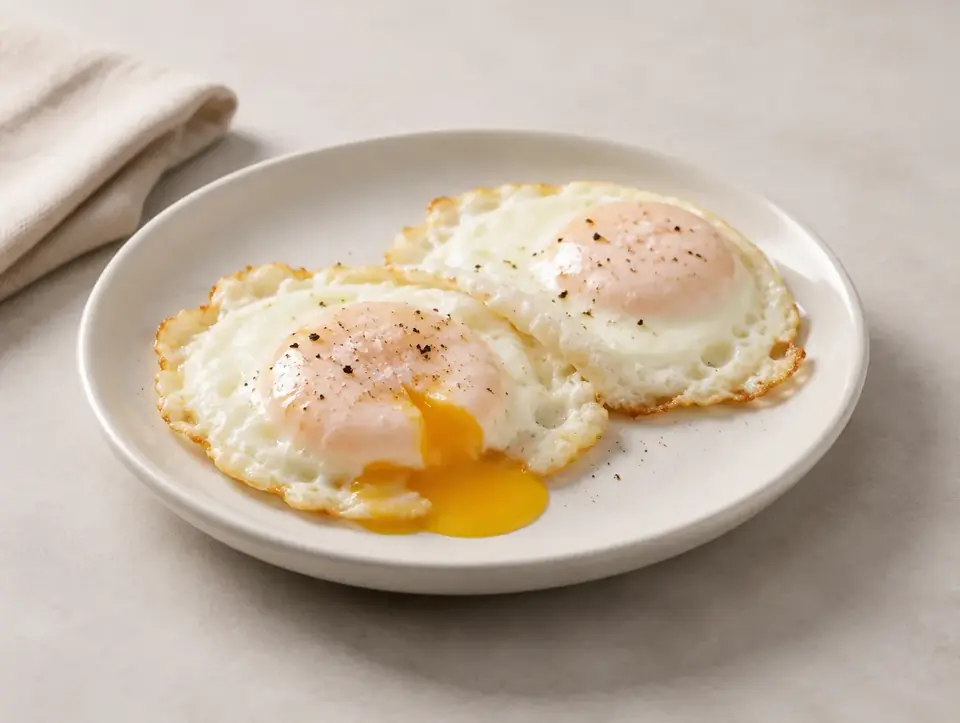
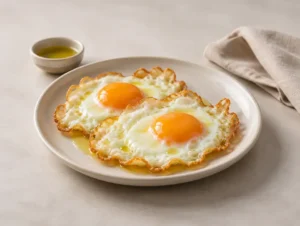
One clean flip, whites cooked through, yolk still liquid under a skin.
At a glance.
Over-Easy Eggs comes from United States · Diner Lingo and appears in The Breakfast Atlas, in the chapter Eggs. It serves 1, takes about 5 minutes, and uses 5 ingredients and 9 steps.
- Yield
- Serves 1
- Method
- Stovetop
- Time
- 5 minutes
Ingredients
Tap an ingredient to tick it off.
Method
-
Use a well-seasoned or nonstick 20 cm (8 in) pan with sloping sides. Straight sides give a spatula nowhere to enter cleanly, and a sticking egg is a broken egg the moment you attempt the turn.
-
Crack the eggs into two cups. Set the pan over medium heat, add the butter, and swirl it as it melts so the base and the lower curve of the sides are coated.
-
Slip the eggs in from a low height once the foam quiets. Keep them apart — fused whites cannot be flipped separately, and separating them later tears both.
-
Cook undisturbed for 90 seconds to 2 minutes. The whites should be opaque all the way to the yolk with no clear jelly at the collar, and the underside pale gold rather than dark.
-
Shake the pan gently. Both eggs should slide as units; if either grips, work a thin spatula underneath and free it before you commit to the flip.
-
Slide a thin, flexible fish spatula fully under one egg, past the yolk, so the whole egg is supported. A partly supported egg folds in the air and bursts.
-
Lift about 3 cm and turn your wrist over in one decisive motion, laying the egg down rather than dropping it. Repeat with the second. Confidence matters more than speed.
-
Cook the second side 30 seconds for over easy, 60 for over medium, 90 for over medium-well, 2 minutes for over hard. Touch the yolk: liquid feels loose and shifting, jammy feels springy and full.
-
Turn the eggs back onto a warmed plate so the presentation side faces up, season with salt and pepper, and serve immediately with hot sauce if you use it.
Cook’s notes
- The technique
- The flip works or fails before the spatula moves. An egg releases from a pan only once the proteins touching the surface have set and contracted away from it, at around 70°C on the base — roughly the moment the top of the white turns opaque. Flip earlier and the raw underside is still bonded to the metal and will tear. Test by shaking the pan, never by prying.
- Make ahead
- Nothing can be done ahead, and over-easy eggs must not be held; residual heat in the whites cooks the yolk through within minutes. Sequence the plate instead — coffee poured, toast buttered, bacon resting — so the eggs are cooked last and eaten first.
- Troubleshooting
- Yolk breaks in the flip — the spatula was too small or the lift too high; support the whole egg and keep it close to the pan. Egg sticks — the pan was not hot enough at the start, or under-fatted. Yolk cooked hard — you counted the second side in minutes rather than seconds.
- Variations
- Over hard, broken and pressed flat, is the standard for a breakfast sandwich. In the Philippines, a similarly flipped egg tops silog plates of garlic rice and cured meat. A Japanese variant fries the egg in sesame oil and finishes it with soy on the second side.
- Serve with
- Hash browns or home fries, toast for the yolk, and bacon or sausage. Corned beef hash with two over easy on top is a classic order in its own right. Filter coffee, or cold milk if you are eating like a trucker.

Where it comes from
No other egg comes with its own vocabulary. To order eggs over easy in an American diner is to specify a technique — fried, then turned once — and a doneness, the yolk still fully liquid after roughly thirty seconds on its second side. Over medium takes it to a thickened, jammy center; over medium-well to a yolk barely soft at the core; over hard to one cooked solid, often broken on the griddle first. The vocabulary grew out of the short-order counter, where cooks called orders down the line in compressed shorthand and a customer's exact preference had to travel from booth to griddle in three words. It sits alongside the wider lingo of the American lunch counter, phrases such as Adam and Eve on a raft for two poached eggs on toast, a working slang recorded in newspapers and glossaries from the 1930s onward and now largely retired outside a few old houses. The flip is the entire skill, and it is the one fried-egg technique that will not forgive a heavy hand.
Over-Easy Eggs: quick answers
How long does Over-Easy Eggs take?
About 5 minutes.
How many does this Over-Easy Eggs recipe make?
This recipe serves 1.
Where does Over-Easy Eggs come from?
No other egg comes with its own vocabulary. To order eggs over easy in an American diner is to specify a technique — fried, then turned once — and a doneness, the yolk still fully liquid after roughly thirty seconds on its second side. Over medium takes it to a thickened, jammy center; over medium-well to a yolk barely soft at the core; over hard to one cooked solid, often broken on the griddle first. The vocabulary grew out of the short-order counter, where cooks called orders down the line in compressed shorthand and a customer's exact preference had to travel from booth to griddle in three words. It sits alongside the wider lingo of the American lunch counter, phrases such as Adam and Eve on a raft for two poached eggs on toast, a working slang recorded in newspapers and glossaries from the 1930s onward and now largely retired outside a few old houses. The flip is the entire skill, and it is the one fried-egg technique that will not forgive a heavy hand.
More from United States
More in Eggs
https://www.atlasserie.com/recipes/breakfast/over-easy-eggs/